By Raffay Poonawala, Owner/ Co Founder – Sky Build Mart
Walk into any building materials market in Pakistan today and you will find WPC wall panels stacked high from a dozen different suppliers. Some are locally manufactured. Others, like the Sky Panels range at Sky Build Mart, are imported. On the surface, they can look similar. In practice, however, the difference in quality, durability, and long-term value is significant.
As the Owner and a co founder of Sky Build Mart, I made the decision early on to import rather than source locally. That choice was not made lightly, and it was not made for marketing reasons. It came from direct experience of what local WPC panels look like after two or three years on a wall, compared to what an imported panel looks like over the same period. The gap is noticeable, and this guide explains exactly why.
In this article, we compare local and imported WPC wall panels across every dimension that matters: raw material quality, surface finish, dimensional accuracy, moisture resistance, UV stability, and overall value for money. By the end, you will have a clear picture of what you are actually buying when you choose between the two.
Table of Contents
- What Makes a WPC Wall Panel Good or Bad?
- Raw Material Quality: Where the Difference Begins
- Surface Finish and Woodgrain Accuracy
- Dimensional Accuracy and Consistency
- Moisture Resistance and UV Stability
- Lifespan and Long-Term Performance
- Why Sky Build Mart Imports Sky Panels
- Cost Comparison: Cheap Now vs Costly Later
- Who Should Buy Local and Who Should Buy Imported?
- Frequently Asked Questions
- Conclusion
1. What Makes a WPC Wall Panel Good or Bad?
Before comparing local and imported panels, it is worth establishing what separates a high-quality WPC wall panel from a poor one. Because WPC is a composite material, its quality is determined not by a single factor but by several interacting variables. Understanding these helps you evaluate any panel, regardless of where it comes from.
The Four Quality Pillars of WPC
First, the wood-to-polymer ratio matters enormously. Too much wood flour and the panel absorbs moisture and swells. Too much polymer and the surface becomes slippery, hard to bond with adhesive, and loses the warm, natural feel that makes WPC appealing in the first place. Premium panels maintain a carefully calibrated balance, typically between 50 and 60 percent wood content, which delivers both stability and aesthetics.
Second, the surface layer quality is what you see and touch every day. On a good WPC panel, this layer is co-extruded directly onto the core, meaning it bonds chemically rather than just adhering mechanically. On cheaper panels, a thin film is laminated onto the surface using adhesive. The laminated approach looks similar initially, but it separates, bubbles, and peels over time, particularly in humid conditions.
Third, additive quality determines how the panel performs in real-world conditions. UV stabilisers prevent colour fading near windows. Fungicides prevent mould growth in bathrooms and kitchens. Fire retardants improve safety classifications. Premium manufacturing uses consistent, food-grade or pharmaceutical-grade additives. Budget manufacturing cuts corners here because these additives are expensive and invisible to the buyer at the point of sale.
Fourth, extrusion precision affects how cleanly panels fit together on a wall. If the profile tolerances are inconsistent, panels will not align properly, gaps will appear between slats, and the finished installation will look uneven regardless of how carefully it was installed. This is one of the most overlooked aspects of WPC quality, and it is one of the areas where local and imported panels differ most sharply.
2. Raw Material Quality: Where the Difference Begins
The quality gap between local and imported WPC wall panels starts before a single panel is extruded. It starts with the raw materials that go into the mix. Understanding this helps explain why two panels that look almost identical in a showroom can perform so differently once they are on a wall.
Wood Flour Quality and Sourcing
Premium WPC manufacturing uses wood flour that has been dried to a precise moisture content, typically below 3 percent, before it enters the extrusion process. This is essential because any residual moisture in the wood flour creates steam during extrusion, which forms micro-bubbles in the panel core. These bubbles weaken the panel structurally and reduce its resistance to moisture ingress over time.
Local WPC manufacturers in Pakistan often source wood flour from sawmill waste without consistent quality control over moisture content. As a result, panel batches can vary significantly in their internal density and structural integrity, even from the same supplier. Furthermore, the wood species used affects the final panel quality. Hardwood flour produces denser, stronger panels than softwood flour, and imported manufacturers typically specify the wood species used in their production process, whereas local suppliers rarely do.
Polymer Grade and Recycled Content
The polymer binder used in WPC production also varies considerably in quality. Virgin PVC or HDPE produces more consistent results than recycled polymer, but it costs more. Many local manufacturers use high proportions of recycled or off-grade polymer to reduce costs. While this is not always detrimental, it introduces variability in the polymer’s flow characteristics during extrusion, which in turn affects the panel’s surface smoothness, colour consistency, and dimensional accuracy.
Imported Sky Panels products, by contrast, are manufactured to consistent polymer grade specifications. This consistency is what allows the woodgrain surface finish to reproduce accurately across every panel in a production run. In short, the investment in raw material quality at the manufacturing stage is what delivers the visual and structural consistency you see in the finished panel.
3. Surface Finish and Woodgrain Accuracy
For most buyers, the surface finish is the first and most obvious point of comparison. After all, it is what the eye sees and what the hand touches. However, surface quality is also one of the most difficult things to assess quickly in a showroom, because the differences that matter most only become apparent over time.
Co-Extrusion vs Surface Lamination
As noted above, premium WPC panels use a co-extruded surface layer, meaning the decorative woodgrain finish is bonded to the core during the extrusion process itself. This creates a surface that is mechanically and chemically integral to the panel. It cannot peel, bubble, or separate under normal conditions because there is no adhesive layer to fail.
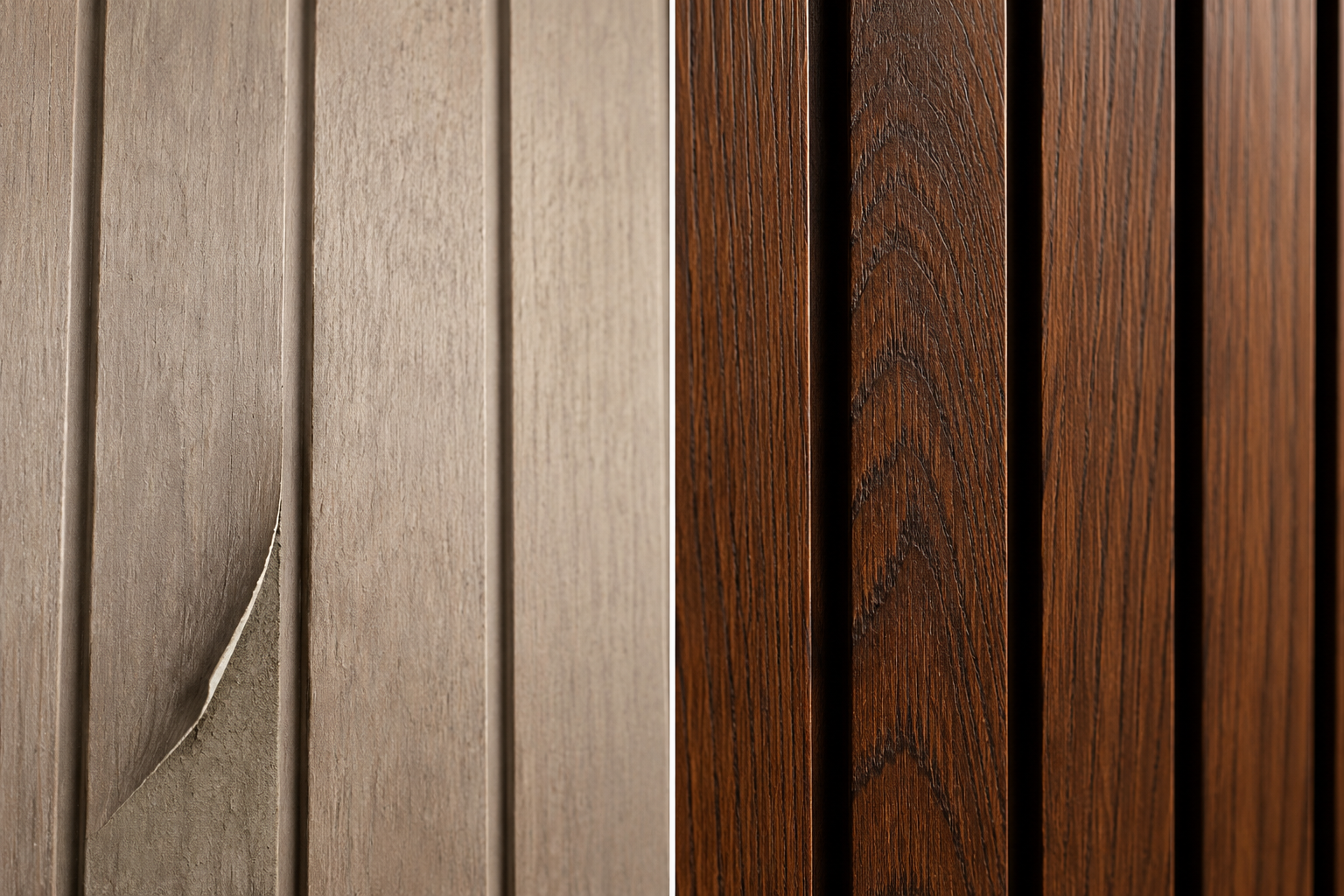
Many locally manufactured WPC panels use a post-extrusion lamination process instead. A decorative PVC film is pressed and glued onto the extruded core after it has cooled. Initially, this can look almost identical to a co-extruded finish. Over time, however, the adhesive bond weakens, particularly in humid environments or near heat sources. Corners and edges are the first to show signs of lifting. Once the film begins to separate, moisture can enter between the film and the core, accelerating the delamination process rapidly.
Woodgrain Depth and Realism
Beyond the bonding method, the quality of the woodgrain embossing also differs substantially. Premium imported panels use deep-embossed woodgrain textures that create a tactile surface with real depth and shadow. When light catches the surface at an angle, the grain pattern reads as genuinely three-dimensional. This is particularly important for slatted WPC wall panels, where the play of light across the surface is a central part of the visual effect.
Local panels typically use shallower embossing, partly because the tooling required for deep-grain embossing is expensive to produce and maintain. The result is a surface that looks flat and printed rather than textured and natural. In photographs, the difference is subtle. In person, and especially in directional light, it is immediately noticeable. All 16 finishes in the Sky Panels WPC wall panel collection use deep-embossed woodgrain surfaces for precisely this reason.
Colour Consistency Across Panels
A third surface quality factor is colour consistency across panels within the same batch. When cladding a full wall, you need every panel to match. With imported Sky Panels products, colour consistency is maintained through tightly controlled production parameters. With locally manufactured panels, colour variation between panels from the same batch is common, because the pigment dispersion in lower-grade polymer is less uniform. This shows up most clearly in large installations where multiple panels sit side by side across a wide wall.
4. Dimensional Accuracy and Consistency
Dimensional accuracy is one of the least discussed but most practically important aspects of WPC wall panel quality. It refers to how precisely each panel matches its stated dimensions and profile, and how consistent that precision is across a batch of panels.
Why Tolerances Matter
When you install WPC wall panels, you are typically fitting them edge to edge across a wall surface. If the panels are extruded to tight tolerances, the joints between panels are invisible and the slat lines run continuously and evenly across the wall. If the tolerances are loose, you get visible gaps, uneven slat alignment, and an overall result that looks amateurish regardless of how carefully it was installed.
Imported panels, including the Sky Panels range, are produced on precision extrusion lines that maintain dimensional tolerances of plus or minus 0.2mm or less. This level of precision is standard in quality-controlled manufacturing environments but requires significant capital investment in equipment and process monitoring. Consequently, local manufacturers using lower-specification extrusion lines typically work to tolerances of plus or minus 0.5 to 1mm, which sounds small but creates visible inconsistency at panel joints.
Length Consistency
Panel length consistency is equally important, particularly for floor-to-ceiling installations. If panels vary in length by several millimetres within a batch, you either end up with uneven top or bottom cuts, or you have to trim every panel individually to achieve a consistent result. This adds significant time and cost to the installation. Imported panels are cut to length on precision saws with consistent stop settings, so length variation within a batch is negligible. Local panels are often cut manually or on lower-precision machinery, and length variation of 5 to 10mm within a batch is not uncommon.
5. Moisture Resistance and UV Stability
Pakistan’s climate places specific demands on interior wall materials. Summer humidity in cities like Karachi and Lahore can be extreme, and temperature swings between seasons are significant. These conditions test WPC wall panels in ways that temperate European or North American climates do not. Therefore, moisture resistance and UV stability are not abstract quality metrics for Pakistani buyers. They are practical determinants of how long a panel will look good on a wall.
Moisture Resistance: How WPC Panels Fail
WPC panels fail in humid conditions through two main mechanisms. First, moisture enters the panel core through cut edges, fixing holes, or surface defects, causing the wood flour content to swell. This swelling puts pressure on the surface layer and can cause cracking, bulging, or delamination. Second, moisture accumulates between the surface film and the core on laminated panels, accelerating film separation as described in the surface finish section above.
Premium imported panels address both failure modes. The co-extruded surface layer eliminates the film separation risk. Additionally, the wood flour in premium panels is treated with moisture-resistant coatings before extrusion, and the polymer blend includes moisture-resistant additives that reduce the rate at which water can migrate into the core through cut edges. Local panels rarely specify moisture resistance additives in their composition, largely because these additives add cost that buyers cannot see at point of sale.
UV Stability in Pakistani Conditions
UV fading is a significant concern for wall panels used near large windows in Pakistan, where solar intensity is considerably higher than in Northern European countries where many WPC testing standards were developed. Interior WPC panels are not designed for direct outdoor UV exposure, but they do need to resist the UV levels typical of a south-facing room with large glazing.
Premium imported panels include UV stabiliser packages formulated for high solar intensity environments. As a result, colour fade in normal interior conditions is minimal for the first ten years. Local panels vary enormously in their UV stabiliser content. Some perform adequately. Others show visible fading within 18 to 24 months in sunlit rooms, particularly in darker finishes where colour shift is most noticeable. According to industry guidance from BSI Group’s construction standards division, UV degradation in composite materials is directly linked to the quality and concentration of stabiliser additives used in manufacturing, not simply to the material type.
6. Lifespan and Long-Term Performance
Ultimately, every quality difference discussed above translates into one practical outcome: how long the panel continues to look good and perform its function. This is where the cost-benefit case for imported WPC panels becomes most compelling.
Typical Lifespan Comparison
| Quality Category | Typical Lifespan | Common Failure Mode | Replacement Cost |
|---|---|---|---|
| Budget local panels | 2 to 4 years | Surface film peeling, colour fade | Full replacement needed |
| Mid-range local panels | 5 to 8 years | Edge swelling, joint gaps | Partial or full replacement |
| Imported Sky Panels (WPC) | 15 to 25 years | Minimal under normal use | Replacement rarely required |
These figures are not theoretical. They reflect what we have observed across installations in Pakistan and what is consistent with performance data from WPC markets in the Middle East and South Asia, where climate conditions are comparable. Moreover, the replacement cost of a panel installation is not simply the cost of new panels. It also includes the labour cost of removal and reinstallation, any damage to the underlying wall during removal, and the disruption to the space during the process. When these factors are included, a cheaper local panel that needs replacing every three to four years costs significantly more over a ten-year period than an imported panel that lasts fifteen years or more.
Warranty and After-Sales Support
Another practical aspect of lifespan is warranty coverage. Imported Sky Panels products come with manufacturer quality assurance that backs up the performance claims. Local panel suppliers in Pakistan rarely offer formal warranties on their products, partly because the product specifications are not documented clearly enough to support a warranty claim. If a local panel fails early, the buyer typically has no recourse. By contrast, purchasing from Sky Build Mart means buying from a supplier who stands behind the product and can address quality concerns directly.
7. Why Sky Build Mart Imports Sky Panels
At Sky Build Mart, we import the Sky Panels WPC wall panel range because, after evaluating the local market thoroughly, we concluded that no locally available product met the quality standard we wanted to offer our customers. That is a blunt assessment, but it is an honest one.
The Sourcing Decision
When we developed the Sky Panels range, the brief was specific: produce a WPC wall panel that looks genuinely premium, performs reliably in Pakistan’s climate, and holds its appearance over a realistic lifespan. We evaluated local manufacturing options first, because importing adds cost and complexity to the supply chain. However, after reviewing local production capabilities, it became clear that achieving our quality standards was not possible without either importing finished panels or building a manufacturing facility from scratch. Given that the latter was not viable at our scale, importing was the logical choice.
What the Import Process Involves
Importing WPC wall panels is not simply a matter of buying cheaper products from abroad and marking them up. The process involves specifying exact material compositions, surface textures, profile tolerances, and colour standards with the manufacturer. It involves quality inspection at the production facility before shipping. Furthermore, it involves managing logistics to ensure panels arrive undamaged and within acceptable timeframes for our customers.
Each of the 16 finishes in the Sky Panels range was selected based on its suitability for Pakistani interior design preferences and its performance in conditions comparable to Pakistan’s climate. The thickness options, 17mm and 24mm, reflect the two most common application contexts in the Pakistani market: standard residential installations and premium commercial fit-outs.
Supporting Pakistani Interiors With Global Standards
Some customers ask whether buying imported products is the right choice when local alternatives exist. It is a fair question and one we take seriously. Our view is that Pakistani homeowners, designers, and contractors deserve access to the same quality of materials that are available in Dubai, London, or Singapore. The fact that a product is imported does not make it better by default. However, when local manufacturing cannot yet match the quality standard required, importing is the responsible choice. We remain open to sourcing locally as soon as local production meets the standard the Sky Panels name represents.
8. Cost Comparison: Cheap Now vs Costly Later
Price is often the first objection to imported WPC wall panels. Local panels are cheaper per panel at point of sale, and for budget-conscious buyers this difference can seem decisive. However, a closer look at the total cost of ownership tells a different story.
The True Cost of a Budget Panel
Consider a typical bedroom feature wall installation covering 12 square metres. Using budget local panels at a lower per-unit cost might save a meaningful amount upfront compared to Sky Panels. Nevertheless, if those local panels begin to show surface film peeling, colour fade, or edge swelling within two to three years, the wall needs to be addressed. At that point, the buyer faces three options: live with a deteriorating wall, patch individual panels (which rarely matches well), or strip and replace the entire installation.
Stripping and replacing a 12 square metre panel installation involves the cost of new panels, labour for removal and reinstallation, disposal of the old panels, and potentially replastering or repainting the underlying wall if the removal process damages it. In practice, therefore, a budget local installation that lasts three years and requires full replacement costs more over a six-year period than a Sky Panels installation that requires no intervention over the same period.
The Value Calculation for Commercial Projects
For commercial projects, the cost argument in favour of imported panels is even stronger. A restaurant or hotel that installs wall panels cannot afford to have them deteriorate visibly within two years. The reputational cost of a shabby interior is far greater than the upfront premium for quality materials. Additionally, commercial installations typically cover much larger areas than residential ones, which means the labour cost of replacement is proportionally higher. Specifying Sky Panels at the outset is not a luxury decision for commercial clients. Rather, it is a sound financial one.
9. Who Should Buy Local and Who Should Buy Imported?
In the interest of balance, it is worth acknowledging that local WPC panels are not universally the wrong choice. There are specific contexts where they can be a reasonable option, and being honest about this serves buyers better than a blanket recommendation.
When Local Panels Can Work
Local panels may be suitable for temporary installations where longevity is not a priority, such as exhibition stands, pop-up retail spaces, or event staging. In these contexts, the lower upfront cost makes sense because the installation is not expected to last more than a few months. Similarly, for very large-area, low-visibility installations in storage or utility areas where appearance matters less, local panels can serve their purpose adequately.
Moreover, if a project has a very tight budget and the choice is genuinely between local panels or no panels at all, local panels provide the slatted aesthetic at a lower entry price. In that scenario, choosing locally made panels over a bare wall is a reasonable decision, provided the buyer understands the lifespan limitations.
When Imported Sky Panels Are the Right Choice
For any installation where appearance, longevity, and performance matter, imported Sky Panels are the better investment. This includes all residential feature walls in living rooms, bedrooms, and home offices, where the panels will be seen and touched every day. It also includes all commercial installations, from restaurants and hotels to offices and retail spaces, where the wall panels are part of the brand experience the space creates.
Additionally, any installation in a humid environment, such as a bathroom feature wall or a space with limited ventilation, requires the moisture resistance and surface integrity that only a premium co-extruded imported panel delivers reliably. Explore the full range of Sky Panels WPC wall panels at Sky Build Mart to find the right finish and thickness for your project.
10. Frequently Asked Questions
How can I tell if a WPC panel is locally made or imported?
The most reliable indicators are the product documentation and the supplier’s transparency about the manufacturing source. Imported panels like Sky Panels come with clear country-of-origin information and product specifications. Additionally, you can check the surface quality by running your fingernail firmly across the woodgrain. On a co-extruded imported panel, the grain texture is integral to the surface and will not scratch or lift. On a locally laminated panel, you may be able to feel the edge of the film layer at corners or cut edges.
Are imported WPC wall panels significantly more expensive than local ones?
There is a price difference, yes. However, the gap is smaller than many buyers expect, particularly when you factor in the total cost of ownership over five to ten years. For a bedroom feature wall, the upfront price difference between local and imported panels is typically a fraction of the total installation cost. Given the lifespan difference, the per-year cost of an imported Sky Panels installation is often lower than that of a cheaper local alternative that needs replacing after three years.
Do Sky Panels WPC wall panels come with a guarantee?
Yes. Sky Panels products are backed by Sky Build Mart’s quality assurance, and we stand behind the products we supply. If you experience a quality issue with a Sky Panels WPC wall panel, contact us directly and we will address it. This level of after-sales support is simply not available from most local panel suppliers.
Which Sky Panels WPC wall panel thickness should I choose?
For most residential applications, the 17mm thickness is the right choice. For high-ceiling commercial spaces or premium feature walls where maximum visual depth is the goal, the 24mm thickness delivers a noticeably more dramatic shadow line between slats. Our full buyer’s guide covers this in more detail if you need further guidance.
Can I see the Sky Panels WPC range before buying?
You can browse all 16 finishes with full product descriptions on the Sky Panels brand page at Sky Build Mart. If you would like to assess a specific finish before committing to a full order, contact us through the website to discuss sample options.
11. Conclusion
The difference between local and imported WPC wall panels is not simply a matter of price or origin. It is a difference in raw material quality, manufacturing precision, surface integrity, moisture resistance, and long-term performance. At every level, premium imported panels like the Sky Panels range outperform their locally made counterparts in ways that matter to anyone who wants a wall that still looks good five, ten, or fifteen years after installation.
At Sky Build Mart, we import because we believe Pakistani customers deserve the same quality of interior materials that is standard in more developed construction markets. The Sky Panels WPC wall panel range, available in 16 finishes across 17mm and 24mm thickness profiles, represents that commitment. Whether you are fitting out a bedroom, a restaurant, or an entire office floor, choosing Sky Panels means choosing a product that has been specified, sourced, and quality-checked to perform. Browse the full Sky Panels WPC wall panel collection at Sky Build Mart and find the right panel for your project.
Raffay Poonawala, Owner/ Co Founder, Sky Build Mart
