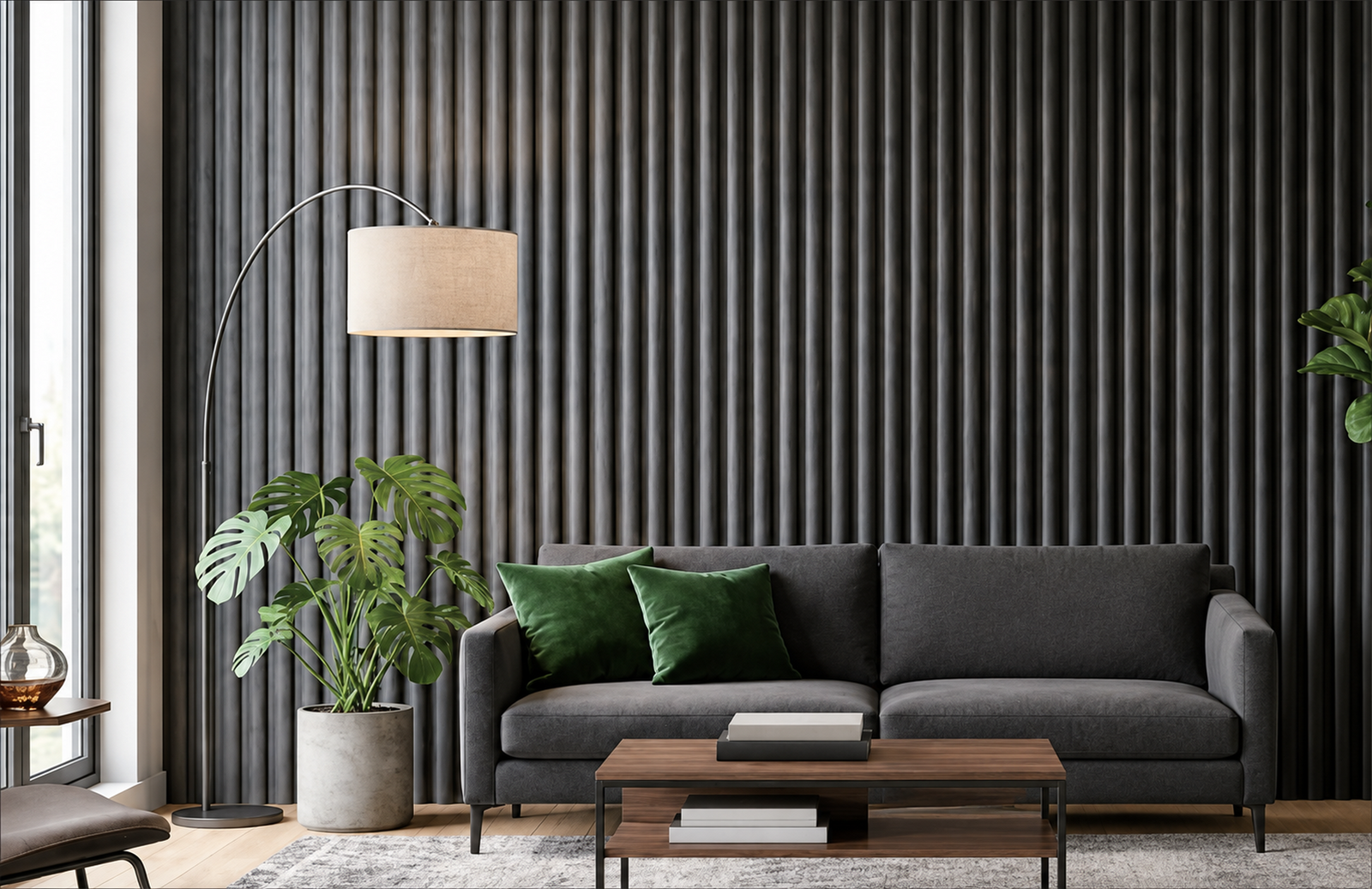
WPC wall panel guide
Slat wall panels are the profile most people picture when they think of a modern feature wall: evenly spaced vertical strips of wood over a dark backing, running floor to ceiling behind a TV, a bed or a reception desk. They have become the signature look of new Pakistani interiors, from DHA apartments to Clifton cafes, and for good reason.
Shop slat panelsThis guide explains what slat wall panels are, the eight finishes Sky Build Mart offers, where the profile works best, how it compares with round slat and deep fluted panels, how to work out quantities and how the panels are fitted and kept clean in Karachi conditions.
What are slat wall panels?
Slat wall panels are WPC (wood plastic composite) boards shaped into flat-topped strips with grooves between them, so the finished wall looks like individual timber slats fixed over a recessed background. Each panel is 9.5 ft (2900 mm) long and carries several slats, which is why a slat wall goes up in a day rather than the week a carpenter would need to fix real timber battens one by one.
WPC blends wood fibre with a plastic polymer. It resists moisture better than solid wood, does not warp in humidity the way timber does, and needs no varnish or repainting. The wood grain finish is part of the board.
Width, thickness and the number of slats per panel are listed on each product page. You can see the full range in our slat panels category.
Which slat wall panel finishes can you choose?
Sky Build Mart stocks eight slat panel finishes: Natural Oak, Ash Grey, Coffee Brown, Dark Walnut, Espresso Walnut, Graphite Brown, Matte Black and Walnut with Oak Inlay. At the time of writing they are listed at the same price per panel, so your choice is about the room rather than the budget. Check the product page for the current rate.
- Natural Oak and Ash Grey. Light and airy. They suit small rooms, Scandinavian-style interiors, white walls and light floors.
- Coffee Brown and Dark Walnut. Warm, classic wood tones that match most Pakistani furniture and wooden doors. The safest choice for a living room or bedroom.
- Espresso Walnut and Graphite Brown. Deeper and more dramatic. They need good lighting and suit larger rooms and TV walls.
- Matte Black. Bold and modern. It makes a TV almost disappear into the wall and suits offices and contemporary lounges.
- Walnut with Oak Inlay. Two tones in one panel, with lighter oak strips set into walnut. It gives a designed look without mixing products.
View finishes in daylight and under your own lamps. Warm bulbs push browns towards orange and cool bulbs push greys towards blue.
Where do slat wall panels work best?
- TV walls. The classic use. Slats frame the screen, hide cables when fitted on battens and look dramatic under a warm LED strip.
- Bed backdrops. A slat wall behind the headboard gives a boutique hotel look.
- Reception and office walls. Slats behind a desk look professional and photograph well. Our office wall panels guide covers commercial use.
- Room dividers and partitions. Slats on a timber frame separate a lounge from a dining area while letting light through.
- Staircase walls and corridors. Vertical slats make a low or narrow space feel taller.
- Restaurants and cafes. Slat walls soften a hard, echoing room and set a warm mood.
Slat wall panels vs round slat and fluted panels
Three Sky Build Mart profiles give a vertical look, and they are not the same.
- Slat panels have flat-topped strips with crisp edges and clear grooves. They give the sharpest, most architectural lines.
- Round slat panels have rounded ribs at 15 mm thick. The look is softer, with no hard edges, and suits bedrooms and counter fronts.
- 24mm fluted panels are deeper, so the shadows between grooves are stronger. They suit large statement walls and lit TV walls.
If you want clean modern lines, choose slat panels. If you want softness, choose round slat. If you want maximum depth and shadow, choose 24 mm.
How many slat wall panels do you need?
- Measure the wall width at three heights and use the largest figure.
- Divide by the panel cover width shown on the product page and round up.
- Add 5 to 10 percent for cutting and keep one spare from the same batch.
- Check the height. At 9.5 ft, one panel covers most walls without a joint. For higher ceilings, finish at a trim or lit shelf.
- Plan the end panels so that cut panels at each side are equal, and so that cuts fall in a groove rather than through a slat.
- Order trims and end caps with the panels.
How are slat wall panels installed?
Slat wall panels are glued to a flat, dry wall or fixed to battens. Battens are the better choice for TV walls, because they leave space for cables and let you add solid backing for the bracket.
- Check the wall for damp and repair any seepage. Let it dry.
- Run cables and conduit for the TV, sockets and LED strips before the panels go up.
- Mark a true vertical line and fit the first panel plumb.
- Work across the wall, checking that the groove spacing stays even across every joint.
- Leave small expansion gaps at top and bottom and cover them with trim.
- Cut around sockets and let the switch plate sit on the slat face.
- Fix the TV bracket through the panel into masonry or a batten, never into the panel alone.
A skilled team finishes a typical TV wall in about a day, longer with battens and wiring. Read our WPC wall panels explained guide for more on the material.
Karachi humidity, heat and cleaning
WPC copes well with humid air, but it needs a dry wall underneath. Check for salt marks, bubbling paint or rain stains, fix the source and let the wall dry. Keep panels away from stoves, heaters and hot UPS units. Karachi dust settles in the grooves between slats, so run a soft brush or vacuum attachment along the grooves weekly and wipe marks with a damp cloth and mild soap. Avoid abrasive pads and strong chemicals.
When slat wall panels are not the right choice
- Damp walls. Repair first.
- Wet areas and cooking walls. Use tiles.
- Very small, dim rooms with dark finishes. Choose Natural Oak or Ash Grey, or a flat panel.
- Walls where chairs scrape all day. Flat panels or UV marble sheets take knocks better.
- Whole-house budgets. Use slats on one feature wall and paint the rest.
Frequently Asked Questions
Are slat wall panels real wood?
No. They are WPC, a composite of wood fibre and plastic with a wood grain finish. They look like timber but resist moisture and termites better and need no varnish.
Can I hide TV cables behind slat wall panels?
Yes, if the panels are fitted on battens. The gap behind the panels takes conduit for HDMI, power and network cables. Plan socket positions before fitting.
Which slat finish is best for a small room?
Natural Oak or Ash Grey. Light finishes reflect light and keep a small room feeling open. Dark finishes such as Matte Black suit larger rooms with good lighting.
How long do slat wall panels last?
Fitted on a dry wall and cleaned gently, WPC slat panels last for many years without fading, warping or repainting. Read our lifespan guide for detail.
Do slat wall panels help with noise?
They break up flat reflective surfaces and make a room feel calmer, but they are not a full acoustic treatment. Add soft furnishings for serious noise problems.
Can slat wall panels be used as a room divider?
Yes. Fixed to a timber frame, they make an open partition that separates spaces while letting light through. Ask us about fixing methods before you order.
