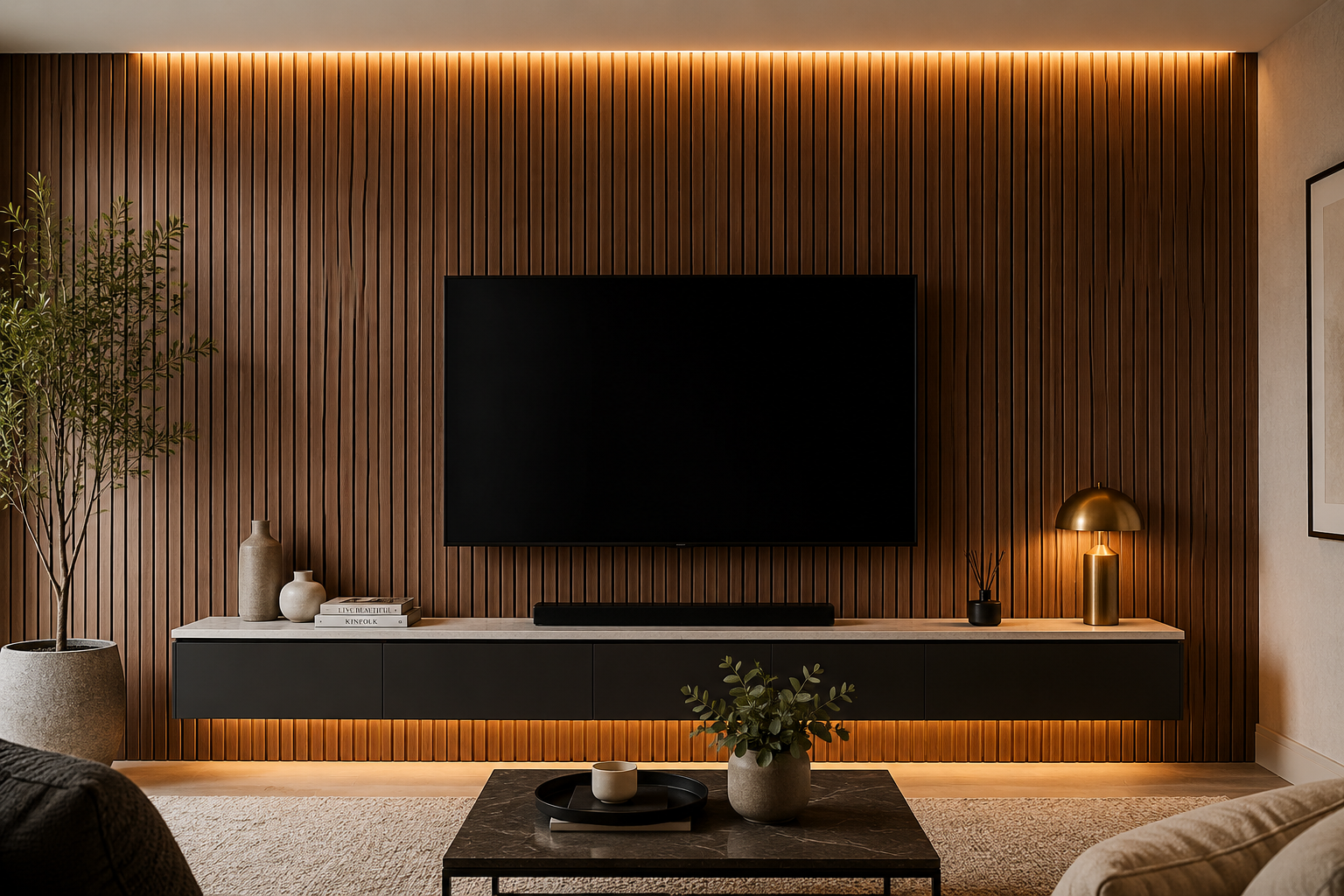
Homeowners across Pakistan increasingly ask the same question before starting an interior renovation: what are WPC wall panels, and are they actually worth the investment? The short answer is that WPC wall panels have quietly become one of the most practical wall finishing materials available today. However, the longer answer involves understanding exactly what the material is made of, how it performs against humidity and everyday wear, and why it has overtaken plain wood and plastic sheeting in kitchens, bedrooms, and offices from Karachi to Peshawar.
At Sky Build Mart, our in-house brand Sky Panels produces 16 premium WPC wall panel designs, each engineered to resist moisture, resist warping, and deliver a genuine wood-look finish without the cost or upkeep of solid timber. Consequently, the range has become a go-to choice for feature walls, ceilings, wardrobes, and commercial interiors right across the country.
In this guide, we explain precisely what WPC wall panels are, how the material compares to solid wood, MDF, and PVC, and why Sky Panels’ construction stands apart from generic imports. Additionally, we cover which design suits which room, and by the end, you will understand exactly why WPC wall panels have become the sensible choice for Pakistani homes and businesses.
Every Sky Panels WPC wall panel is priced from PKR 1,900up to PKR 2,000 per panel, depending on design. Sixteen wood-effect designs, honest pricing, delivery available across Pakistan.
- What Are WPC Wall Panels?
- WPC vs Solid Wood, MDF, and PVC: The Honest Comparison
- The Sky Panels Difference
- The Sky Panels WPC Wall Panel Range: All 16 Designs
- Room-by-Room Guide: Which Panel Works Where
- How to Install WPC Wall Panels: Step by Step
- Caring for Your WPC Wall Panels
- WPC Wall Panels and the Pakistani Interior Design Trend
- Frequently Asked Questions
- Conclusion
1. What Are WPC Wall Panels?
WPC stands for wood plastic composite. In practice, WPC wall panels are decorative wall coverings made by combining wood fibre, typically sourced from sawdust or wood pulp, with a polymer resin such as PVC or PE, then compressing the mixture under heat into rigid, dimensionally stable boards. Consequently, the result is a panel that carries the appearance and grain texture of real timber while behaving far more like plastic when exposed to moisture, insects, or temperature change.
Unlike a thin decorative laminate, a WPC wall panel is a solid board, available in a choice of thicknesses depending on the application, with the wood-grain finish embossed or printed directly onto the surface and then sealed. Furthermore, most WPC panels are manufactured with a grooved or click-fit profile along the edges, which allows panels to interlock during installation and hide the joins almost completely once fitted.
What the Material Is Made Of
A typical WPC wall panel is composed of roughly 60 percent wood fibre and 30 to 40 percent polymer, along with small quantities of bonding agents and pigments. This composition matters because it determines the panel’s core behaviour. Specifically, the wood fibre gives the board its natural texture and workability, allowing it to be cut, drilled, and screwed much like timber. The polymer component, by contrast, is what makes the panel resistant to moisture absorption, since plastic does not swell or rot the way solid wood does when it comes into contact with water.
Consequently, a well-made WPC wall panel offers a genuine middle ground: the warmth and visual character of wood, combined with the practical resilience of plastic. This is precisely why Sky Panels has built its entire wall panel range around this material rather than plain MDF or laminate sheeting.
Panel Thickness and Sizing
Sky Panels WPC boards are available in two standard thicknesses, 17mm and 24mm, so the specification can be matched to the demands of the room. The 17mm option suits most residential feature walls, where the priority is a lighter board that is easy to handle and fit. By contrast, the 24mm option offers greater rigidity and impact resistance, which makes it the preferred choice for high-traffic commercial areas such as reception desks, corridors, and retail fit-outs. Moreover, keeping the range to two clearly defined thicknesses simplifies planning considerably for larger installations across Karachi, Lahore, and Islamabad, since the right specification can be confirmed before an order is placed.
2. WPC vs Solid Wood, MDF, and PVC: The Honest Comparison
Every buyer eventually asks how WPC wall panels genuinely compare to the alternatives already familiar in Pakistani interiors. Solid wood, MDF, and plain PVC sheeting have all been used for decades, and therefore an honest, side-by-side comparison is the fastest way to understand where WPC actually earns its reputation.
Performance Across the Four Materials
| Factor | Solid Wood | MDF Panelling | Plain PVC Sheet | Sky Panels WPC |
|---|---|---|---|---|
| Cost per panel in Pakistan | PKR 8,000 to 20,000+ | PKR 3,000 to 4,500 | PKR 2,500 to 3,500 | PKR 1,900 to 2,000 |
| Moisture resistance | Poor, warps and rots | Poor, swells quickly | Good | Excellent |
| Termite and pest resistance | Poor without treatment | Poor | Excellent | Excellent |
| Visual authenticity | Genuine wood grain | Requires veneer or laminate | Flat, plastic look | Realistic embossed wood grain |
| Installation | Skilled carpentry required | Moderate skill required | Simple, lightweight | Click-fit, DIY friendly |
| Weight | Heavy | Moderate | Light | Light to moderate |
| Maintenance | Polishing, sealing, treatment | Careful cleaning only | Wipe clean | Wipe clean, no sealing |
| Typical lifespan | Long, if maintained | Short in humid rooms | Moderate | Long, low maintenance |
As the table illustrates, WPC occupies the strongest overall position. It undercuts plain PVC sheeting on price while comfortably outperforming it on visual authenticity, and it comfortably beats solid wood on moisture resistance, pest resistance, and long-term maintenance. Therefore, for Pakistani homes that face genuine humidity swings between seasons, WPC represents the more sensible long-term choice.
Why Moisture Resistance Matters in Pakistan
Pakistan’s climate varies considerably between cities, yet humidity remains a consistent challenge in coastal Karachi, monsoon-affected Lahore, and even in the drier climates of Islamabad and Rawalpindi during certain months. Solid wood panelling absorbs ambient moisture, which causes swelling, cracking, and eventual warping over a few seasons. MDF behaves even worse under sustained humidity, since its compressed fibre core disintegrates once water penetrates the surface layer. WPC panels, by contrast, are engineered specifically to resist this failure mode, which is why they have become the preferred choice in bathrooms, kitchens, and basements across Faisalabad and Peshawar as much as in the major coastal cities.
3. The Sky Panels Difference
Not every WPC panel sold in Pakistan is manufactured to the same standard. This category has grown quickly, and consequently that growth has brought a wide spread in quality between premium panels and cheaper, thinner imports. Understanding the difference, therefore, helps explain why Sky Panels has built a loyal following among homeowners and interior designers alike.
Sky Panels vs Generic Market WPC
| Factor | Generic Market WPC | Sky Panels WPC Wall Panels |
|---|---|---|
| Core density | Inconsistent, often hollow-filled | Dense, evenly compressed core |
| Surface finish | Flat print, low texture depth | Embossed grain with UV-protected top coat |
| Panel joint system | Basic tongue and groove | Precision click-fit for seamless joins |
| Colour consistency across panels | Noticeable batch variation | Matched consistently across the full order |
| Price per panel | Varies widely, often unclear | PKR 1,900 to 2,000, fixed premium specification |
Additionally, every Sky Panels board is finished with a UV-protected top layer, which prevents the colour from fading under direct sunlight near windows and balconies. Generic imports frequently skip this step to reduce cost, and the difference becomes obvious within a year of installation as the surface dulls unevenly.
Built for Practical Installation
The precision click-fit edge on every Sky Panels board is a deliberate design choice. Similarly to how laminate flooring locks together, each panel slots into the next without visible gaps, which means a wall covered in Sky Panels boards reads as a single continuous surface rather than a row of separate sheets. As a result, installation teams across Karachi, Lahore, and Islamabad consistently report faster fitting times and a noticeably cleaner finish compared with generic alternatives.
For a broader industry perspective on how composite wall materials are assessed, Grand View Research’s market analysis of wood plastic composites notes that demand for the category has grown steadily as builders look for materials combining natural aesthetics with lower maintenance requirements. This trend, in practice, is reflected clearly in the growing popularity of WPC across Pakistani interiors.
4. The Sky Panels WPC Wall Panel Range: All 16 Designs
The Sky Panels WPC wall panel collection spans classic timber tones, deep espresso shades, and light contemporary finishes. Every design, moreover, is priced between PKR 1,900 and PKR 2,000 per panel. Here is the complete range, organised by tone family.
Classic Wood Tones
These six designs replicate the warm, traditional timber shades most familiar in Pakistani homes. As a result, they suit almost any room where a natural, welcoming feel is the priority.
- Golden Oak WPC Wall PanelWarm honey-toned oak grain with visible natural texture. A versatile all-rounder for living rooms, studies, and hallways.
- Amber Walnut WPC Wall PanelRich mid-brown walnut tone with fine grain detailing. Popular for TV feature walls and office panelling alike.
- Royal Teak WPC Wall PanelClassic teak colouring with subtle amber undertones. A dependable choice that suits traditional Pakistani interiors.
- Mahogany Luxe WPC Wall PanelDeep reddish-brown finish with pronounced grain lines. Suited to formal dining rooms and reception areas.
- Heritage Walnut WPC Wall PanelDeep, traditional walnut tone with a slightly darker undertone than Amber Walnut. Works well in libraries and home offices.
- Honey Cedar WPC Wall PanelSoft warm cedar shade with gentle grain movement. A relaxed, versatile option for bedrooms and lounges.
Dark and Espresso Tones
For interiors with a more contemporary or dramatic intent, the darker end of the range delivers depth and sophistication. Consequently, these tones rarely need accent lighting to carry the effect.
- Midnight Ash WPC Wall PanelDeep charcoal-black ash tone with fine linear grain. A striking choice for statement feature walls.
- Shadow Oak WPC Wall PanelNear-black oak finish with subtle grain texture. Creates a bold, modern backdrop for cinema rooms and studies.
- Espresso Line WPC Wall PanelRich espresso-brown finish with warm undertones. Popular for wardrobes, panelling, and accent walls.
- Shadow Drift WPC Wall PanelSmoky charcoal-brown tone with pronounced grain contrast. Suits industrial and minimalist interior styles.
- Walnut Crest WPC Wall PanelDeep, dramatic walnut tone with pronounced grain detailing. A confident choice for master bedrooms and boardrooms.
Light and Natural Tones
The lighter designs in the range suit smaller rooms, bathrooms, and any space where the goal is an airy, contemporary finish. In addition, they work well as a neutral base for bolder furniture and accessories.
- Ash Stone WPC Wall PanelCool grey-toned wood grain with a contemporary, stone-inspired edge. Pairs well with monochrome and industrial interiors.
- Ivory Pine WPC Wall PanelBright, near-white pine finish with soft grain lines. Ideal for brightening smaller rooms and hallways.
- Frost Timber WPC Wall PanelPale, frosted timber tone with a clean, contemporary character. A favourite for children’s bedrooms and studies.
- Oak Crest WPC Wall PanelFresh, light oak colouring with visible grain character. Suited to casual living spaces and balconies.
- Walnut Ridge WPC Wall PanelSoft, muted walnut tone with a fine, understated grain. A neutral option that works in almost any colour scheme.
Colour and Lighting Considerations
Choosing between a light and a dark WPC panel often comes down to how a room is lit rather than personal taste alone. Rooms with limited natural light, such as internal hallways or north-facing bedrooms, generally suit lighter tones like Ivory Pine or Frost Timber, since darker panels can make an already dim space feel smaller. By contrast, rooms with generous natural light or strong artificial lighting can carry deeper tones such as Midnight Ash without feeling closed in. Similarly, smaller flats in Karachi and Lahore tend to benefit from lighter finishes, while larger open-plan homes in Islamabad and Rawalpindi can absorb the drama of a darker panel comfortably.
Curved WPC Wall Panels
Beyond the 16 flat panel designs, Sky Panels also offers four curved WPC wall panels for installations that call for a softer, sculptural profile. These are made to order, and consequently pricing is confirmed on request rather than fixed like the standard flat range.
- Natural Oak WPC Curved Wall PanelWarm natural oak grain on a gently curved profile. Suits feature columns, reception desks, and rounded partition walls.
- Teak WPC Curved Wall PanelClassic teak tone shaped into a smooth curved panel. Popular for hotel lobbies and boutique retail fit-outs.
- Walnut WPC Curved Wall PanelRich walnut finish on a curved format. Creates a striking, sculptural feature in larger commercial spaces.
- White Oak WPC Curved Wall PanelBright white oak tone with a soft curve. Suited to contemporary showrooms and light-filled reception areas.
5. Room-by-Room Guide: Which Panel Works Where
Selecting the right WPC wall panel design depends on the room’s existing palette, its lighting, and how the space is actually used day to day. Therefore, the following guide reflects the most common applications requested by Sky Build Mart customers across Pakistan.
Living Room Feature Wall
A TV backdrop or sofa wall is the most requested application, and warm classic tones tend to perform best here. For example, Amber Walnut and Golden Oak suit traditional Pakistani living rooms, while Ash Stone and Shadow Drift deliver a cooler, more contemporary result.
Bedroom
For a headboard wall, softer tones create a calmer atmosphere. Honey Cedar, Frost Timber, and Ivory Pine are frequently chosen for this purpose. Nevertheless, for a more dramatic master bedroom, Midnight Ash or Shadow Oak create an unmistakable statement.
Kitchen and Bathroom
Because WPC resists moisture so effectively, it performs well behind sinks, in utility areas, and on bathroom walls outside the direct shower spray zone. Similarly, Ivory Pine and Walnut Ridge are particularly popular for kitchens in Lahore and Islamabad, keeping the space bright while remaining practical to clean.
Office and Commercial Interiors
Pakistan’s growing commercial fit-out sector has adopted WPC panelling quickly, largely because it installs faster than solid wood panelling and holds up better in high-traffic areas. Consequently, Royal Teak, Heritage Walnut, and Espresso Line are commonly requested for reception areas and boardrooms in Karachi and Rawalpindi.
6. How to Install WPC Wall Panels: Step by Step
One of the strongest practical advantages of WPC wall panels over solid timber panelling is installation speed. No specialist joinery is required, and most feature walls can be completed by two people within a single day. Following the correct sequence, however, makes a noticeable difference to the finished result.
Surface Preparation
Ensure the wall is clean, dry, and free of loose paint or plaster before starting. Additionally, any significant unevenness should be corrected first, since WPC panels will telegraph major surface irregularities. Freshly plastered walls, therefore, should be left to cure fully, typically two to three weeks, before panels are fitted.
Framing and Layout
Most installations use a light timber or metal batten frame fixed to the wall, onto which the panels are then clicked or screwed. In addition, plan the batten spacing according to the panel dimensions, and mark the centre point of the wall so the layout is symmetrical. Use a spirit level for the first batten, as every subsequent panel aligns from it.
Fitting the Panels
Starting from one edge, slot each panel’s tongue into the groove of the previous one, then secure it to the batten frame with concealed fixings. Furthermore, work steadily across the wall, checking alignment every two to three panels rather than waiting until the end. For reference on substrate preparation and fixing standards for wall coverings, the BSI Group construction standards provide useful general guidance.
Finishing Touches
Trim edge profiles are typically added around doors, windows, and corners to give the installation a finished, professional appearance. Additionally, check every panel edge for a secure click before considering the job complete, since a loose join is far easier to correct immediately than after the wall is fully dressed.
7. Caring for Your WPC Wall Panels
Sky Panels WPC wall panels are designed for low maintenance living. In most households, a dry or lightly damp cloth is sufficient to keep the surface looking new. A few simple habits, however, will extend the panel’s appearance well beyond the average lifespan of a comparable timber installation.
Routine Cleaning
Dust the surface regularly with a soft microfibre cloth. For example, marks or light grease respond well to a damp cloth with a mild detergent. Always wipe along the grain rather than against it, and dry the surface immediately afterwards to avoid streaking.
What to Avoid
- Abrasive scouring pads, which can scratch the embossed texture
- Strong solvents or bleach-based cleaners, which may dull the UV-protected top coat
- Standing water left pooled against the base of the panel for extended periods
- Heavy impact from sharp furniture edges, which can chip the surface finish
Long-Term Care
Check panel joints periodically, particularly in rooms with fluctuating temperature, and ensure fixings remain secure. Similarly, keep panels away from direct, prolonged contact with open flame or extreme heat sources, as the polymer content will soften under sustained high temperatures.
8. WPC Wall Panels and the Pakistani Interior Design Trend
Pakistan’s interior design sector has shifted noticeably over the past several years. Furthermore, rising expectations, exposure to Gulf and international design trends, and the sheer volume of home renovation content on Instagram, TikTok, and Pinterest have all pushed homeowners towards finishes that look considered rather than purely functional.
Why Wood-Look Panelling Resonates in Pakistan
Timber panelling has long carried an association with craftsmanship and warmth in Pakistani homes, from traditional wooden ceilings to carved doors and furniture. Consequently, WPC wall panels bring that same warmth into a home far more affordably and far more practically, which explains why demand has grown steadily across Karachi, Lahore, Islamabad, Rawalpindi, Faisalabad, and Peshawar. According to the Designing Buildings wiki on wall coverings, composite panelling has become one of the fastest-growing categories in interior finishing precisely because it combines natural aesthetics with lower long-term maintenance demands, a pattern that mirrors what Sky Build Mart sees in the Pakistani market directly.
Sustainability and the Composite Advantage
Additionally, WPC panels appeal to a growing segment of environmentally conscious buyers, since the wood fibre content typically uses recycled sawdust and offcuts rather than freshly felled timber. The World Green Building Council has highlighted the broader importance of material choices that reduce demand on virgin timber, and composite panelling fits neatly within that direction. If you have already explored our marble wall sticker collection, you will notice a similar philosophy at work: premium appearance, delivered through smarter materials rather than costlier ones.
9. Frequently Asked Questions
WPC stands for wood plastic composite. Specifically, it refers to a building material made by combining wood fibre with a polymer resin, then compressing the mixture into rigid boards. As a result, the same material is used for wall panels, flooring, decking, and furniture.
WPC panels are highly moisture resistant rather than fully submersible. They will not swell, rot, or warp from everyday humidity, splashes, or steam, which makes them suitable for kitchens and most bathroom walls. However, they are not designed for areas with constant standing water or direct, sustained shower spray.
For most residential feature walls, the 17mm option is sufficient and easier to handle during fitting. In commercial areas with heavier foot traffic, such as reception desks or corridors, the 24mm option offers greater rigidity. Additionally, share your wall measurements through the Sky Panels collection page and our team will confirm the right specification and exact panel quantity for your project.
In most cases, yes, provided the existing surface is flat, sound, and securely fixed to the wall. Moreover, a batten frame is typically used, which means the panels do not need to bond directly to the surface beneath them. Nevertheless, a short site assessment is recommended for uneven or damaged walls.
Yes. Because the polymer content surrounds the wood fibre, WPC panels offer significantly better termite and pest resistance than solid timber. Consequently, this is one of the main reasons they have become popular across Pakistan’s varied climate zones.
Sky Panels WPC wall panels are priced between PKR 1,900 and PKR 2,000 per panel, depending on the design, not per square metre. Furthermore, all 16 flat panel designs in the Sky Panels WPC wall panel collection fall within this range, with no hidden costs.
Standard Sky Panels WPC boards are designed for interior use. However, while the polymer core resists moisture better than solid wood, prolonged direct sun and rain exposure outdoors will eventually affect the surface finish. In practice, a covered veranda with indirect exposure suits WPC reasonably well, but a fully exposed exterior wall is better suited to purpose-built outdoor cladding.
For a standard feature wall, two installers can usually complete the batten frame and panel fitting within a single day. By contrast, larger commercial installations across multiple rooms, such as an office fit-out in Lahore or Islamabad, typically take two to four days depending on wall complexity and total coverage area.
All 16 premium Sky Panels WPC wall panel designs are available now from PKR 1,900 per panel. Browse the full range and find the right wood-effect finish for your home or commercial project.
Shop All WPC Wall Panels Explore Sky Panels10. Conclusion
WPC wall panels answer a genuine problem in Pakistani interiors: the desire for a natural, wood-look finish that does not fall apart under humidity, warp with the seasons, or demand constant upkeep. By combining wood fibre with a durable polymer core, the material delivers the warmth of timber alongside the resilience of plastic. Moreover, it does so at a price that remains realistic for most renovation budgets.
With 16 designs spanning classic oak and walnut, deep charcoal and espresso, and light contemporary tones such as ivory pine and frost timber, the Sky Panels collection covers every direction a Pakistani interior might take. Whether you are finishing a bedroom in Karachi, panelling an office in Lahore, upgrading a kitchen in Islamabad, or fitting out a reception area in Rawalpindi, therefore, there is a design in this range built for the job. Browse the full collection at Sky Build Mart and see the difference for yourself.
