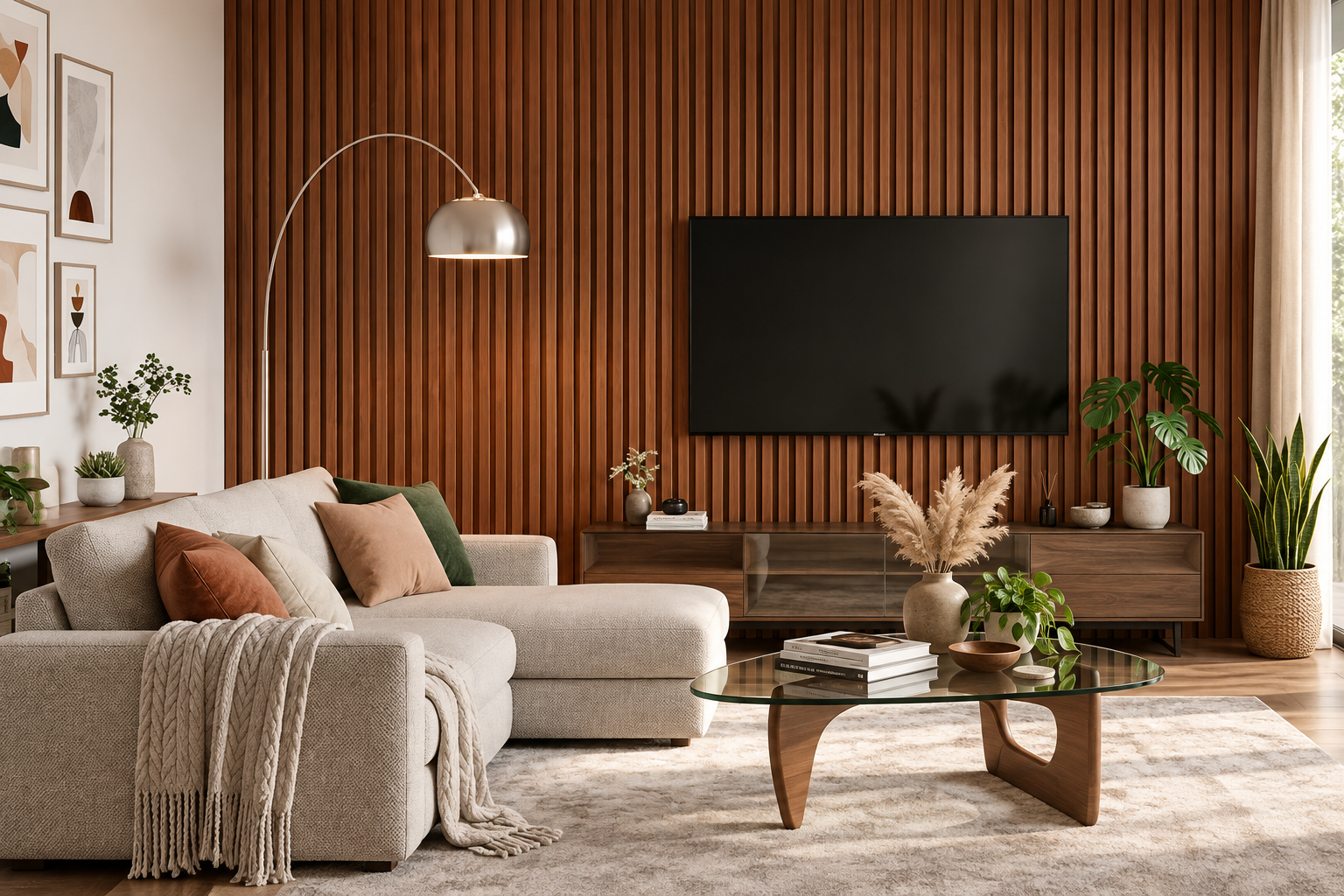
TV wall panels are the quickest way to turn a plain lounge wall into the focal point of the room. A well-planned panel wall hides cables, frames the screen and gives the space warmth, without the cost and mess of custom carpentry.
This guide covers seven ideas that work in Pakistani homes, which panel profile suits which room, and how to plan the wall so the TV, wiring and lighting all line up. Every product mentioned is part of the Sky Build Mart WPC range, and all panels are 9.5 ft (2900mm) long.
In this guide
- Why choose TV wall panels?
- 7 TV wall panel ideas that work
- Which panel profile suits your TV wall?
- How to plan your TV wall panels step by step
- Mounting the TV, wiring and LED lighting
- Mistakes to avoid
- Frequently asked questions
- Get help planning your TV wall
Why choose TV wall panels?
A TV wall is the one wall everyone looks at every evening. Paint shows marks from cables and brackets, and wallpaper struggles in Karachi humidity. TV wall panels solve both problems with a hard, wipeable surface that does not need repainting.
WPC, or wood plastic composite, blends wood fibre with plastic. Research from the US Forest Products Laboratory found that wood plastic composites take up moisture more slowly than solid wood, which is why they suit humid cities better than timber or MDF. That does not make them a fix for damp walls, so any seepage must be repaired first.
Panels also make cable management easier. Fitted on battens, they leave a gap behind the surface for conduit, so HDMI and power cables disappear completely.
7 TV wall panel ideas that work
Each idea below uses TV wall panels from our range. Pick one main idea for your wall rather than mixing several.
1. Deep wood slats for TV wall panels with real shadow
Our 24mm WPC wall panels stand out further from the wall, so the grooves cast strong vertical shadows. This is the classic hotel-lounge look. Wood tones such as walnut, oak and cedar work in most living rooms.
2. Round slat panels for a softer look
If deep grooves feel too strong for your room, round slat panels give the same vertical rhythm with gentle rounded ribs. Each panel is 158mm wide and 15mm thick, so it sits closer to the wall.
3. Flat wood grain as a calm backdrop
When the TV unit already has shelves, lights and décor, a quieter wall helps. Flat wood grain panels give a smooth timber surface with no grooves, which is also the easiest finish to dust.
4. A dark slat wall with LED backlighting
Black, charcoal and espresso finishes make the screen look larger and reduce glare around it in the evening. Pair them with a warm LED strip along the top edge. Browse the slat panels range for darker tones.
5. Wood panels with a marble or foil centre
Run TV wall panels on both sides and use a contrasting centre strip behind the screen. A golden foil sticker or marble finish adds shine without a second heavy material. See our golden foil wall stickers.
6. Panels with a floating console and shelf
A wall-hung console below the TV keeps the floor clear and makes cleaning easier. Plan the console height before fitting, because its brackets need solid backing behind the panels.
7. Curved panels around a column or corner
Many Karachi flats have a column beside the TV wall. Instead of hiding it, wrap it. Our curved WPC wall panels are made for this, and they tie the column into the main wall design.
Which panel profile suits your TV wall?
With TV wall panels, the profile changes the mood more than the colour does. Use this table to narrow your choice before looking at finishes.
| Profile | Look | Best for | Watch out for |
|---|---|---|---|
| 24mm WPC panels | Deep grooves, strong shadow | Large lounges, statement walls | Can feel heavy in small rooms |
| Round slat panels (15mm) | Soft rounded ribs | Family lounges, bedrooms with a TV | Less shadow than 24mm |
| Flat wood grain panels | Smooth timber face | Busy TV units, minimal rooms | Seams show any lean in fitting |
| Slat panels | Crisp vertical lines | Modern and dark schemes | Dark finishes show dust sooner |
| Curved panels | Rounded wrap | Columns and corners | Check the bend before ordering |
How to plan your TV wall panels step by step
Good planning matters more than the panel you choose. Follow these steps before you order TV wall panels.
- Check the wall for damp. Look for salt marks, bubbling paint or stains after rain. Fix any seepage first.
- Measure the width at three heights. Older flats are rarely square, so use the largest figure.
- Decide the panel area. Full wall, or a centre section with plain paint either side.
- Work out the quantity. Divide the width by the panel width shown on the product page, round up, and add 5 to 10 percent for cutting.
- Mark the TV height. The centre of the screen usually sits near eye level when seated. Mark it on the wall before any TV wall panels go up.
- Plan sockets, cables and lights. Mark every socket, TV point and LED position before fitting.
- Choose adhesive or battens. Battens suit uneven walls and hidden conduit.
- Check the ceiling height. Panels are 9.5 ft long. On taller walls, finish the top with a trim or ledge.
Mounting the TV, wiring and LED lighting
Never hang a TV from TV wall panels alone. The bracket must go through to solid backing, either the masonry wall or a timber batten fixed to it. Most TVs and brackets follow the VESA flat display mounting standard, so check your TV’s hole pattern and weight before buying a bracket.
Wiring behind TV wall panels
Run HDMI, network and power cables in conduit before the first panel goes up. Leave a socket behind the TV and a cable exit near the console. Moving a socket later means cutting panels.
LED lighting and load shedding
A warm white LED strip along the top or behind the TV shows off the panel texture. According to the US Department of Energy, LEDs use up to 90 percent less energy than incandescent bulbs, so many families run them on the UPS circuit. Ask your electrician to confirm this for your system, and never box a UPS or inverter behind panels, because they need airflow.
Mistakes to avoid
- Panelling over damp. The problem grows behind the TV wall panels.
- Too many materials. One main panel and one accent is enough.
- Wiring after fitting. Plan every cable first.
- Hanging the TV on the panel. Always fix into solid backing.
- Ordering from two batches. Order the whole wall at once so colours match.
- Choosing from a phone screen. View finishes in daylight and under your own lamps.
For upkeep once the wall is finished, read our guide to cleaning WPC wall panels. If you are new to the material, start with WPC wall panels explained.
Frequently asked questions
Are TV wall panels good for Karachi humidity?
Yes, WPC panels take up moisture more slowly than solid wood and MDF, so they suit humid coastal air well. They will not fix a damp wall. Repair any seepage and let the wall dry before fitting.
Can I mount a TV directly on WPC panels?
No. The bracket must be fixed through the panel into the masonry wall or a timber batten behind it. Mark the bracket position before the panels go up so you can add solid backing there.
How many panels do I need for a TV wall?
Divide the wall width by the panel width on the product page, round up, and add 5 to 10 percent for cutting. Order everything from one batch so the colour matches. Send us your measurements if you want help.
Which colour is best for a TV wall?
Dark finishes make the screen look larger and reduce glare in the evening. Mid wood tones suit most TV wall panels in family lounges and match wooden furniture. Light tones help small or dim rooms feel bigger.
How long does it take to fit TV wall panels?
A skilled installer usually finishes typical TV wall panels in about a day. Allow longer if battens, conduit or LED lighting are added. Wall repairs must be done before fitting starts.
Get help planning your TV wall
Send us your wall width, height and a daylight photo, and we will help you choose a profile and work out the quantity. You can contact Sky Build Mart or message us on WhatsApp. For more room ideas, visit the Sky Build Mart blog.
