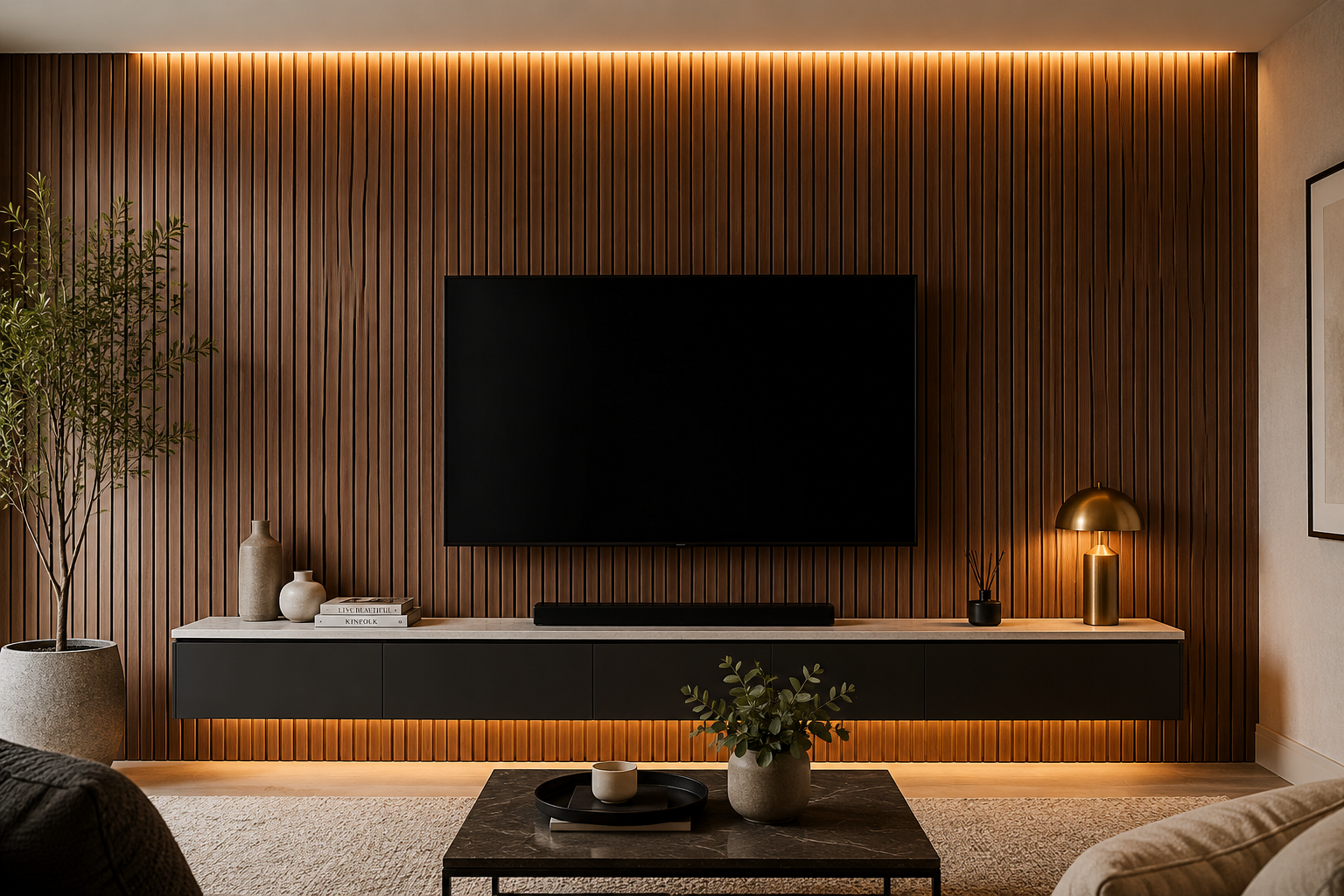
Lighting guide
LED lighting for wall panels is the difference between a wall that looks nice and a wall that looks like a showroom photo. The same slat panel that looks flat under a central ceiling bulb comes alive when a warm strip washes down it from above, throwing long shadows into every groove. Lighting costs a fraction of the panels and does half the work.
Browse WPC wall panelsThis guide explains where to place LED strips, which colour temperature suits each finish, how to hide the light source, how to wire it safely with load shedding in mind, and the mistakes that make a lit wall look cheap. It applies to WPC panels, UV marble sheets and decorative stickers from Sky Build Mart.
Why lighting matters so much for panels
Texture is shadow, which is why LED lighting for wall panels matters more than the panel colour. A 24 mm fluted panel has deep grooves, but you only see the depth when light hits the ribs at an angle and the grooves fall into shadow. Light from straight in front fills the grooves and flattens the wall. Light from above, below or the side creates the contrast that makes panels look three-dimensional.
The same applies to gold foil and marble. Gold catches light that moves across it. Marble gloss reflects a lit line. Plan the light with the wall, not after it.
Where to place LED lighting for wall panels
- Above the wall, washing down. A strip concealed in a ceiling cove, pelmet or shelf above the panels. The most common and most effective position for slats and flutes. Shadows run the full height.
- Below, grazing up. A strip behind a floating console, bed base or skirting ledge. It adds depth and a floating effect. Combine with a top strip for a full wash.
- Behind the TV. A strip around the back of the screen gives a soft halo, reduces eye strain and highlights the panel behind.
- Behind a floating shelf or headboard. A hidden strip makes the furniture appear to float and lights the panel behind it.
- Side wash. A vertical strip in a corner or behind a trim lights across the panel. Strong on wave and round slat profiles.
- In a lit ledge where panels stop short of a high ceiling. A practical and attractive solution for tall rooms.
Colour temperature: match the finish
- Warm white, around 2700 to 3000 K. For walnut, oak, cedar, coffee and all wood tones, and for gold foil. It makes wood look rich and gold look like gold.
- Neutral white, around 3500 to 4000 K. For grey, ash, white wood grain and white or grey marble. Clean without being cold.
- Cool white, 5000 K and above. For metal finishes, black panels in commercial spaces and showrooms that want a crisp look. Avoid on wood, which it turns grey.
If you are unsure, warm white suits most Pakistani homes. Choose a dimmable strip so you can soften it in the evening.
Hide the source, show the light
A visible row of LED dots looks cheap. Aim for a soft, continuous glow with the strip itself out of sight.
- Use an aluminium channel with a frosted diffuser for the strip. It spreads the light and hides the dots.
- Recess the channel into a cove, pelmet, shelf or trim so you see the glow on the panel, not the strip.
- Keep a gap of a few centimetres between the strip and the panel so the light can spread before it hits the ribs.
- Angle the strip towards the panel, not the ceiling or the room.
- Choose a high-density strip so the glow is even along the length.
Wiring, safety and load shedding
Plan the electrics before the panels go up. Moving a cable later means cutting panels. Run cables inside the wall or behind panels fitted on battens, and bring them out where the strip, driver and switch will sit.
- Use a quality LED driver rated above the strip load and keep it accessible, not sealed behind the panels, so it can be replaced.
- Low voltage strips are standard and safe near panels, but keep the driver ventilated because it warms up.
- Load shedding. LED strips draw little power, and LEDs use far less energy than old incandescent bulbs, so many families put feature lighting on the UPS circuit so the wall stays lit during outages. Ask your electrician to confirm this for your system.
- Never enclose UPS units, inverters or batteries behind panels. They need airflow.
- Use a licensed electrician for any mains connection.
Lighting by panel type
- 24mm fluted panels. Top wash in warm white. The deeper the groove, the stronger the shadow. See our 24mm WPC wall panels.
- Slat and round slat panels. Top wash or side wash. Round slats glow softly along the curve.
- Flat wood grain panels. A gentle top wash shows the grain without harsh shadow.
- UV marble sheets. Soft, diffused light. A hard point source creates glare on gloss. See our UV marble sheets.
- Golden foil stickers. Side light or a lamp beside the wall makes the gold move. See our golden foil wall stickers.
- Grill and slat stickers. Front light only. Side light reveals that the slats are printed, so skip the top strip.
Mistakes to avoid
- A single central ceiling light with no wall wash. It flattens every panel.
- Cool white on wood. It turns walnut grey.
- Visible LED dots with no diffuser.
- A driver sealed behind the panels where it cannot be replaced.
- Cables planned after the panels are fitted.
- Over-lighting. One soft wash beats three competing strips.
For the panels themselves, start with our WPC wall panels range and send us a photo of the wall if you want advice on where the light should go.
LED lighting for wall panels: a simple shopping list
You do not need a lighting designer for a single feature wall. This is the kit most installers in Karachi use for LED lighting for wall panels.
- LED strip in warm white for wood and gold, neutral white for grey and marble. Choose a high-density strip for an even glow and a dimmable one if you want to soften it at night.
- Aluminium channel with frosted diffuser cut to the wall width, to hide the dots and spread the light.
- LED driver rated comfortably above the strip load, mounted somewhere ventilated and accessible.
- Dimmer or smart controller if you want to adjust brightness from the sofa.
- Cable and conduit run behind the panels or inside the wall before fitting.
- A licensed electrician for the mains connection and the UPS circuit.
Buy the strip and channel before the panels are fitted, so the recess or pelmet can be sized to the channel. Good LED lighting for wall panels is invisible: you see the glow on the wood, never the fitting.
Frequently Asked Questions
What colour LED is best for wood wall panels?
Warm white, around 2700 to 3000 K. It makes wood tones look rich. Cool white turns wood grey.
Where should I put the LED strip for a slat wall?
Above the wall, concealed in a cove, pelmet or shelf, washing down. Add a strip below behind a floating console or bed for a full effect.
Can LED lighting run on a UPS during load shedding?
Usually yes, because LED strips draw little power. Ask your electrician to confirm the load for your UPS and put the driver on that circuit.
Do LED strips get hot near panels?
The strip runs warm, not hot, and is safe near WPC. The driver warms more and should be ventilated and accessible, never sealed behind panels.
Should I light a grill or slat sticker wall?
Only from the front. A sticker has printed slats, so side or top light shows that the surface is flat.
How do I hide the LED strip?
Use an aluminium channel with a frosted diffuser, recess it into a cove, shelf or trim, and angle it at the panel so you see the glow, not the source.
