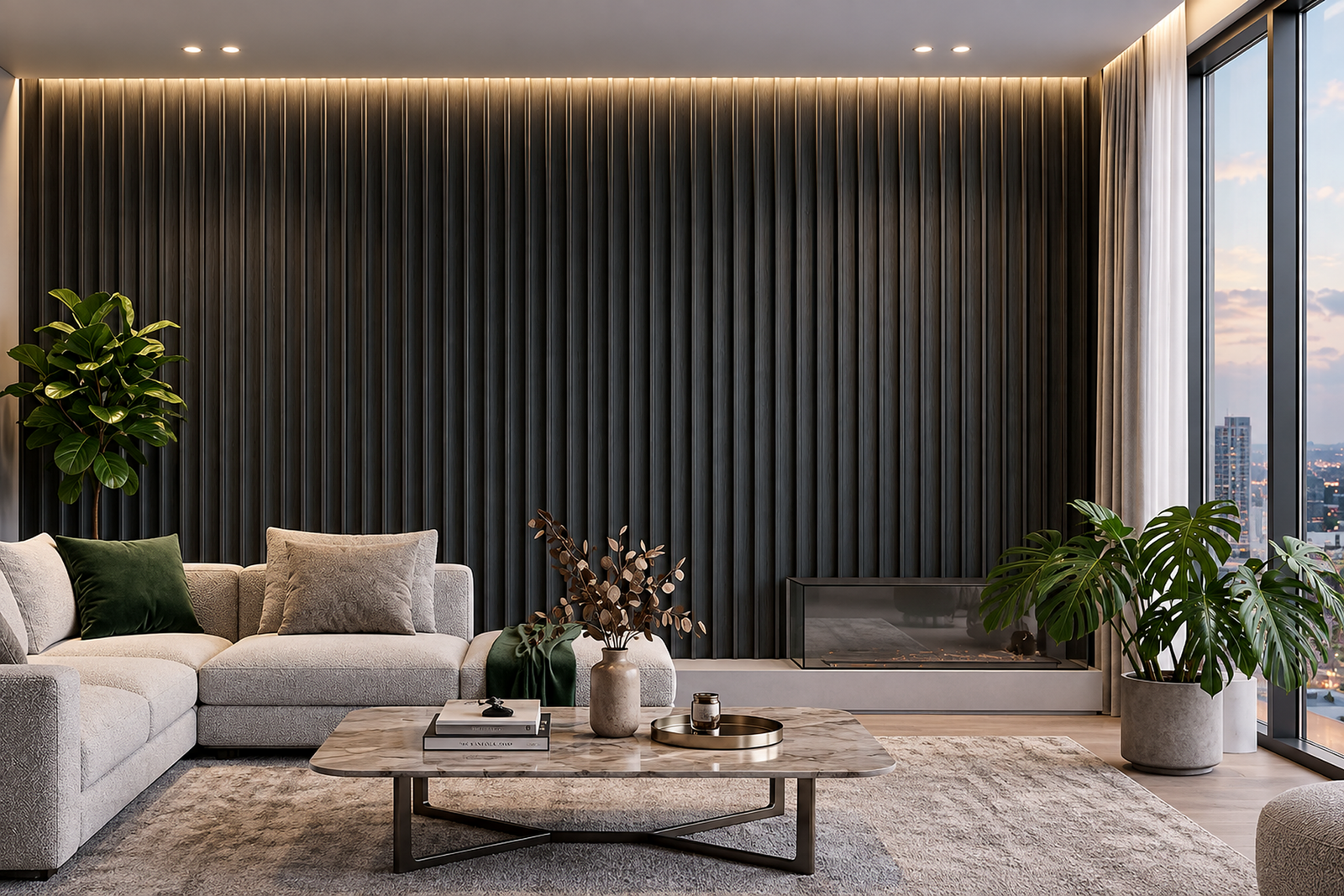
WPC wall panel guide
Wave wall panels bring movement to a flat wall. Instead of straight ribs or a smooth face, the surface rises and falls in soft curves, so light rolls across it through the day and the wall never looks quite the same twice. For Karachi homes and businesses that want something more distinctive than a standard slat wall, they are one of the newest options in the Sky Build Mart WPC range.
Shop wave panelsThis guide explains what wave wall panels are, where the profile works best, how to choose a finish and direction, how they are fitted, and where a flatter panel would serve you better. Sky Build Mart stocks six wave designs, and each product page lists the width, thickness and finish for that design.
What are wave wall panels?
Wave wall panels are WPC (wood plastic composite) wall boards with a surface shaped into repeating curves rather than flat ribs. Like all our WPC panels, they are 9.5 ft (2900 mm) long, so they run from floor to ceiling in most rooms without a joint.
WPC blends wood fibre with a plastic polymer. The board resists moisture better than solid timber or MDF, does not attract termites the way wood does, and needs no polish, varnish or repainting. The wave profile is formed during manufacture, so it is part of the board rather than a surface applied afterwards.
Check the exact width and thickness on the product page before ordering, because these decide how many panels you need and how far the wall will stand out from the plaster. You can see the full range in our wave panels category.
How do wave wall panels differ from slat and flat panels?
The difference is in the shadow. A slat panel casts sharp vertical lines. A flat panel casts none. A wave panel casts soft, shifting shadows that follow the curve, so the wall looks sculpted rather than striped.
- Visual rhythm. Waves read as a continuous flowing surface, where slats read as separate lines. The effect is calmer than deep fluting but more expressive than a flat face.
- Light. Side light from a window or wall washer brings out the curves most. Flat overhead light softens them.
- Cleaning. There are no deep grooves to hold dust, but the curved surface still needs a soft cloth run along the shape rather than across it.
- Fitting. The curve must line up from one panel to the next. A small misalignment that a slat wall would hide shows on a wave wall, so setting out matters.
If you want crisp lines, see our slat panels. If you want no pattern at all, see the flat wood grain panels.
Where do wave wall panels look best?
Wave wall panels suit walls where the surface itself is the feature, with little else in front of it. The more you cover the wall with shelves and pictures, the less the curves can do.
- Bed backdrop. A wave wall behind the bed gives a hotel feel, and the soft profile is pleasant to sit against.
- Behind the sofa. A single wave wall gives a living room a focal point without any artwork.
- Reception and lobby walls. Hotels, clinics, salons and offices use wave walls behind the desk because they photograph well and look designed.
- Dining feature wall. Soft light across the curves suits evening meals.
- Corridor end walls. One panelled wall at the end of a corridor draws the eye and makes the space feel longer.
- Ceilings. On a feature ceiling above a dining table or bed, waves give depth without feeling heavy. Ask your installer about fixing methods for ceilings before you order.
Choosing a finish and a direction
Wave wall panels come in wood tones and solid colours. The rules for choosing are the same as for any feature wall: light colours open up small or dim rooms, mid wood tones suit most homes, and dark finishes need good lighting and a larger room.
Direction matters more with waves than with any other profile. Vertical waves lift the ceiling and are the standard choice. Horizontal waves widen a narrow wall and suit a low headboard or a long reception counter. Decide before the wall is prepared, because battens must run across the direction of the panels.
Look at the finish in daylight and under your own evening lamps before you decide. Product photos are a guide, and the wave profile looks different under every light.
How many wave wall panels do you need?
Divide the wall width by the panel cover width, round up, and add 5 to 10 percent for cutting. Cover width is the width of the panel once it is joined to its neighbour, and it is listed on the product page.
- Measure the wall width at three heights. Use the largest figure, because walls in older Karachi buildings are rarely square.
- Divide by the cover width from the product page and round up to a whole panel.
- Add 5 to 10 percent for cuts and one spare for the future.
- Check the height. At 9.5 ft, one panel covers most walls. For taller walls, stop the panels at a trim or lit ledge rather than joining them end to end.
- Order trims with the panels. End caps and corner trims finish the cut edges and are usually bought separately.
How are wave wall panels installed?
Wave wall panels are glued to a flat, dry wall with panel adhesive or fixed to battens, the same as our other WPC profiles. A skilled installer finishes a typical feature wall in about a day.
- Check the wall for damp and repair any seepage first. Let the wall dry fully.
- Let the panels settle in the room for about 24 hours before fitting.
- Mark a true vertical line with a spirit level or laser. Do not trust the corner of the room.
- Fit the first panel plumb. Every panel after it follows this one.
- Match the wave from panel to panel before pressing each one home. Stand back and check the curve runs continuously across the joint.
- Leave small expansion gaps at the top and bottom and cover them with skirting or trim.
- Cut around sockets carefully and let switch plates sit on the panel face.
- Finish edges with matching trims.
Choose battens over glue when the wall is uneven or when you need to run cables for lighting behind the panels.
Karachi humidity, heat and care
WPC handles humid coastal air well, but it cannot cure a damp wall. Check for salt marks, bubbling paint or stains after rain, fix the cause, and let the wall dry before you fit anything. Keep panels away from stoves, heaters and hot UPS units, and shade west-facing walls from hard afternoon sun.
Dust weekly with a soft cloth or brush, following the curve. Wipe marks with a damp cloth and mild soap, and avoid abrasive pads and strong chemicals. Our guide to cleaning WPC wall panels covers the detail.
When wave wall panels are not the right choice
- Walls crowded with shelves and pictures. The curves need open space to show.
- Damp or seeping walls. Repair first.
- Wet areas and cooking walls. Use tiles where water or heat hits the wall.
- Walls that need a very flat surface for a TV bracket or shelving. Fix brackets through to solid backing, or use a flat panel in that section.
- Tight budgets for a whole room. Paint remains the cheapest way to cover every wall. Use waves for one feature wall.
Frequently Asked Questions
Are wave wall panels suitable for bedrooms?
Yes. A wave wall behind the bed is one of the most popular uses, because the soft profile is comfortable to sit against and the curves give a calm, hotel-style look under bedside lamps.
Can wave wall panels be fitted horizontally?
Yes. Horizontal waves widen a narrow wall and suit long counters and low headboards. Walls wider than 9.5 ft will need staggered end joints, and battens must run vertically to support each panel.
Do wave wall panels collect dust?
Less than deep fluted panels, because there are no narrow grooves. Dust settles in the troughs of the curve and lifts off with a soft cloth or brush run along the shape.
How long are the panels?
Every Sky Build Mart WPC panel is 9.5 ft (2900 mm) long. Width and thickness vary by design and are listed on each product page.
Can I mount a TV on a wave wall?
Only if the bracket is fixed through the panel into the masonry or a timber batten behind it. The curved face is not a flat mounting surface, so many people leave a flat section or panel behind the TV.
Are wave wall panels good for Karachi humidity?
Yes, WPC resists moisture far better than solid wood or MDF. They still need a dry wall underneath, so repair any seepage before fitting.
