New product guide
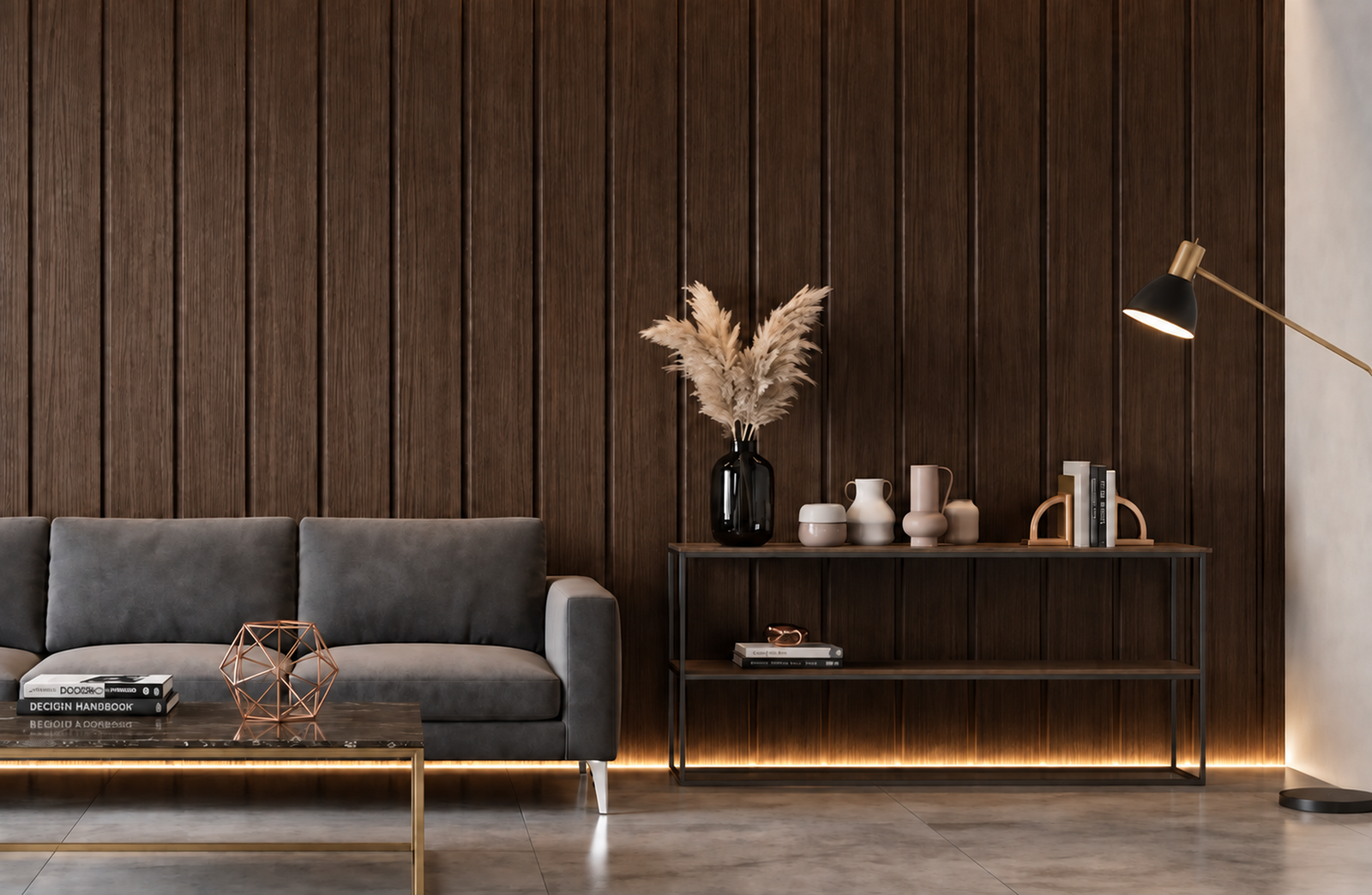
Flat wood grain WPC wall panels have arrived at Sky Build Mart. They give you the warmth of timber cladding on a smooth, flat face, so the wall reads as one calm wood surface instead of a row of ridges.
- 9.5 ftpanel length (2900mm)
- Flat facewood grain finish, no grooves
- WPCwood plastic composite board
Fluted and slatted panels are still the most popular choice for TV walls, but many rooms need something quieter. This guide explains what flat wood grain panels are, where they work best, how to plan a layout, how many you need, how they are fitted, and where they are the wrong choice. It is written for homeowners, contractors, interior designers and shopkeepers who are spending their own money and want to get it right the first time.
A note on specifications and prices: panel width, thickness, finishes and prices can differ between designs and change over time. Always check the product page for the exact size and current rate before you order.
What are flat wood grain WPC wall panels?
Flat wood grain WPC wall panels are long, rigid boards made from wood plastic composite, with a smooth flat face that looks like timber. They have no deep grooves or ridges, so the finished wall shows only thin seam lines between boards.
WPC stands for wood plastic composite. The board is made by mixing wood fibre or wood powder with a plastic polymer and other additives, then shaping it into a panel. The exact blend depends on the manufacturer, which is one reason quality varies between sellers. The wood grain look is added to the surface during production, so each board shows grain, knots or tonal variation without the weight and upkeep of real timber.
Our flat panels are 9.5 ft long (2900mm), the same length as our fluted range. Width and thickness are listed on each product page, and they matter. Width decides how many boards you need and how many seams you will see. Thickness decides how far the finished wall sits out into the room, which is important at door frames, skirting and built-in furniture.
It helps to be clear about what these panels are not. They are not solid wood, so they will not feel or smell like timber, and they cannot be sanded and refinished. They are a finished surface that you fit and leave. That is also their strength: no polish, no varnish, no repainting.
You can see the full range in our flat wood grain WPC wall panels category.
How are flat wood grain panels different from fluted and slatted WPC panels?
Flat panels have a smooth face, while fluted and slatted panels have raised ribs and grooves that cast shadow lines. Flat panels look calm and continuous. Fluted panels look textured and deep.
This one difference changes almost everything about how the wall looks and behaves. Here is how the two compare in practice:
- Light and shadow. Fluted panels create strong vertical shadows, especially under LED strip lighting or side light from a window. Flat panels reflect light evenly, so the wall looks softer and the wood grain becomes the main feature.
- Visual weight. A full wall of deep fluting can feel busy in a small room. A flat wood wall feels quieter and often makes a bedroom or corridor feel more restful.
- Cleaning. Dust settles in grooves. Karachi dust is fine and constant, so a flat face is quicker to wipe than a fluted one.
- Forgiving installation. Fluted panels hide small alignment errors because the eye follows the grooves. A flat panel has long, straight seams that run the full height of the wall. If the first board leans by a few millimetres, the error shows. Flat panels reward careful setting out.
- Feature value. If you want a wall that people notice from the doorway, fluted panels do that better. If you want a wall that quietly makes the whole room look finished, flat panels do that better.
Neither is better in every room. If you want depth and shadow, look at our 24mm WPC wall panels or the slimmer 17mm WPC wall panels. If you want a smooth wood face, start with the flat range.
Where do flat wood grain panels look best in a Pakistani home?
They look best on large, uninterrupted walls where you want warmth without visual noise. Bedroom headboard walls, the wall behind a sofa, entrance halls, corridors and office reception backdrops are the strongest uses.
Here are the places we see them working well, and why:
- Bedroom headboard wall. A single wood wall behind the bed gives a hotel-style look. Flat panels suit this better than deep fluting because you will be sitting and sleeping close to the wall, and a smooth face feels calmer.
- Behind the sofa in a lounge. A flat wood wall gives the sofa a backdrop. Add a framed print or a slim shelf and you are done.
- TV wall as a quiet surround. If your TV wall already has a lot going on, with a console, shelves and lights, a flat wood surface keeps it tidy. You can add LED lighting without competing with grooves.
- Entrance hall or foyer. The first wall a guest sees sets the tone for the home. Flat wood panels make a narrow hall look warm and finished.
- Corridors and stair walls. These walls get brushed by bags, shoulders and children. A hard panel is easier to wipe than paint, and a flat face does not collect dust in grooves.
- Office reception and meeting rooms. A wood wall behind the reception desk looks professional and hides the unfinished plaster that many commercial fit-outs have.
- Shops, clinics and salons. A flat wood back wall gives a clean, branded look and is simple to maintain.
The best results come from choosing one wall as the feature. A single wood wall with plain walls around it looks deliberate. Wood on all four walls often looks heavy and dated.
If you are planning a bedroom, our guide to WPC wall panels for bedrooms covers the room in more detail.
Should I fit flat panels vertically or horizontally?
Fit them vertically in most rooms. Vertical boards make the ceiling feel higher and need no end joints when the wall is 9.5 ft high or lower. Choose horizontal only when you want a narrow wall to feel wider, and accept that you will have more cutting and more joints.
Vertical layout
This is the standard choice. Each board runs from floor to ceiling, so the seams are long clean lines. The eye is pulled upwards, which helps in rooms with low ceilings. Because our panels are 9.5 ft long, a vertical layout needs no end-to-end joints on walls up to that height.
Horizontal layout
Horizontal boards run along the wall. The grain flows sideways, and a short wall appears wider. This works well behind a bed in a narrow room, or on a long corridor wall. The cost is practical. If the wall is wider than 9.5 ft, boards must be joined end to end, and those joints should be staggered like brickwork so they do not line up. Offcuts from each row can start the next row, which reduces waste if the cuts are planned.
Horizontal fixing also changes the battens, if you use them. They must run vertically so that each board is supported along its length. Tell your installer which direction you want before the wall is prepared, not after.
One more point: wood grain printed on a panel has a visual repeat. In a vertical layout you may see the same knot or pattern at a regular interval if you fit boards from one batch in strict order. Ask your installer to mix the boards as they fit them, so the pattern looks natural.
How do I choose the right wood grain colour?
Choose by the room’s light, the colour of your floor and furniture, and how much dust you are willing to wipe. Lighter tones suit small or dim rooms. Mid tones suit most living rooms and bedrooms. Dark tones suit feature walls with good lighting.
Finish names change between designs, so use tone families as your guide:
- Light tones (pale oak, ash, cream, ivory pine styles). They reflect light and make small rooms feel bigger. They also show marks less than very dark finishes. They suit Scandinavian and minimal interiors.
- Mid tones (golden oak, honey, teak styles). They look warm and traditional and match most wooden doors and furniture. For most Pakistani homes, this is the safest range.
- Dark tones (walnut, espresso, charcoal wood styles). They look rich and modern, but they need good lighting, and they show dust and fingerprints quickly. They also make a small room feel smaller.
- Grey and weathered tones. These look contemporary and pair well with white, black and steel fittings. Check them in daylight, because some greys turn blue or green under warm lamps.
Do not choose from a phone or laptop screen alone. Screens change colour, and so do photos. If possible, look at a real piece in the room where it will be used, in morning light and again in the evening under your own lamps. Warm yellow bulbs make many woods look more orange than they do in daylight.
Also think about the floor. If your floor is already wood-look tile or laminate, avoid matching the panel exactly. A slightly lighter or darker panel looks designed. An almost-matching one looks like a mistake.
Finally, remember sunlight. A panel wall that faces a west window will get hard afternoon sun through the summer. Strong, long exposure can fade surfaces over time. Curtains or blinds help.
Can I combine flat panels with fluted panels, stickers or UV marble sheets?
Yes, and it often looks better than using one material alone. Use flat wood panels as the main surface and add one accent: a fluted panel section, a UV marble inset, or a foil sticker on a nearby wall. Keep to one wood tone family.
A few combinations that work:
- Flat main wall, fluted accent strip. Run flat boards across most of a wall and add a vertical band of fluted panels beside a window or behind a lamp. The texture draws the eye without overwhelming the room.
- Flat wood and UV marble. A flat wood wall next to a polished marble-effect wall gives warm and cool contrast. This suits drawing rooms and reception areas. See our UV marble sheets.
- Flat wood and a foil sticker accent. A gold foil panel on a side wall or alcove adds shine without more wood. See golden foil wall stickers.
- Flat wood with a grill sticker. If you want the slatted look on a secondary wall for less money, the grill wall sticker collection is a lighter option. It is a printed finish, not a structural panel, and does not have real depth.
The rules are simple. Use one main material and one accent. Keep woods in the same tone family, because two different timbers next to each other rarely look intentional. And stop before the room feels like a showroom. If you are tempted by a third material, leave one wall plain.
How do flat wood grain panels compare with laminate, veneer, wallpaper and paint?
Flat WPC panels cost more than paint and wallpaper but need far less upkeep. Compared with laminate or veneer fitted by a carpenter, they handle humidity better because the panel itself does not swell like board does. The table below compares them side by side.
| Feature | Flat wood grain WPC panels | Fluted WPC panels | Laminate or veneer on board | Wallpaper | Paint |
|---|---|---|---|---|---|
| What it is | Rigid wood plastic composite board with a flat wood-look face | WPC board with raised ribs and grooves | Laminate or thin wood veneer glued to MDF or plywood, made by a carpenter | Printed paper or vinyl roll | Emulsion or enamel coat |
| Look | Calm, continuous wood surface with thin seams | Textured, with strong shadow lines | Can look very close to wood or real wood | Wide range of patterns, seams visible | Flat colour |
| Humidity and monsoon damp | Good, the board does not swell. Cut edges need trim or sealing | Good, with the same cut-edge care | Weaker. Board can swell and the edges can lift if damp reaches it | Poor. Edges lift and paper can mould on damp walls | Poor on damp walls. Bubbles and peels |
| Hides wall flaws | Partly. Well, if fitted on battens | Well | Depends on the carpentry frame | No, it shows every flaw | No |
| Cleaning | Wipe with a damp cloth. No grooves | Dust collects in the grooves | Wipe clean, but watch the edges | Hard to clean | Marks show, needs repainting |
| Installation | Adhesive or battens, about one day for a typical feature wall | Adhesive or battens, about one day | Several days with a carpenter and a workshop | One to two days, needs a smooth wall | Two to three days with drying |
| Repair | Replace a damaged board if you kept a spare | Replace a damaged board | Hard to repair neatly | Replace a strip, if you can match it | Touch up, which can show |
| Main drawback | Seams run full height and show any lean. Not real timber | Dust in grooves and a busier look | Needs carpentry skill and cost is higher | Short life in humid rooms | Needs repainting |
| Best for | Feature walls, headboards, halls, receptions | TV walls and statement walls | Custom joinery and built-in units | Dry bedrooms on a tight budget | Whole rooms on a tight budget |
If you are comparing local and imported products, see the comparison articles on the Sky Build Mart blog.
How many flat wood grain panels do I need for my wall?
Divide the wall width by the panel’s cover width, round up, then add 5 to 10 percent for cutting and mistakes. Cover width is the width of the board once it is joined to its neighbour, which can be a little less than the overall width.
Here is a worked example for a bedroom headboard wall. The panel width in the example is only an illustration. Check the real figure on the product page before you calculate.
- Measure the wall width. Say the wall is 12 ft wide. That is about 3,658mm.
- Find the cover width. Say the board covers 150mm once fitted.
- Divide. 3,658 divided by 150 is 24.4. Round up to 25 boards.
- Add wastage. Five to ten percent of 25 is about 2 to 3 boards. Order 27 or 28.
- Check the height. If the wall is 9.5 ft or less, each board covers the full height. If it is higher, read the next section before you order.
Some practical points:
- Measure at three heights. Older Karachi flats often have walls that are not square. Measure near the floor, at waist height and near the ceiling, and use the largest figure.
- Plan the first and last board. If the wall width does not divide into whole boards, you will have one narrow cut board. A thin sliver looks bad. Ask your installer to centre the layout so both ends have a cut board of equal width.
- Subtract large openings only. If a door or large window takes up part of the wall, you can reduce the count. For small sockets and switches, do not subtract.
- Order from one batch. Wood grain colour and tone can vary slightly between production runs. Order everything for one wall at once.
- Buy one spare. If a board is damaged in two years, a matching spare is worth more than any discount.
Do not forget trims. End caps, corner pieces and edge trims are bought separately in most systems. Ask us which trims match the finish you have chosen.
What if my ceiling is higher than 9.5 ft?
Then the boards will stop short of the ceiling, and you need to plan how the top of the wall will look. Do not leave it to the installer on the day. Many bungalows and newer apartments have ceilings above 9.5 ft, so this question comes up often.
There are four sensible ways to deal with a taller wall:
- Stop the panels at a deliberate height. Finish the top edge with a trim, a wooden or aluminium ledge, or a shallow shelf with LED lighting. The wall above is painted. This looks intentional and is the most common solution.
- Fit the panels horizontally. Horizontal boards can cover any height, but you will need end joints on wide walls, as described above.
- Use panels as a panelled dado. Run the boards to about door height. This works in corridors and studies and is inexpensive.
- Add a cornice or a plain upper section. A painted strip of a different colour above the panels helps the join look planned.
Do not stack one board on top of another with a bare joint. The join will show, and it becomes the weakest point of the wall. If you must join boards in height, use a horizontal trim to cover the joint and fix the boards to battens.
Measure your ceiling height at several points. Slab ceilings are often not level, and a 10 mm difference across a room is easy to see against a horizontal trim line.
How much do flat wood grain wall panels cost in Pakistan?
The price depends on the panel width, thickness, finish and quantity, so we do not print a single figure here. The current price per panel is on each product page. Plan your budget by adding the panels to the other costs of the job.
Prices change, so check the product page for current rates. Here is how to build a realistic budget for one wall:
- Panels. Number of boards, including wastage, multiplied by the price per board.
- Fixing materials. Panel adhesive, or battens and fixings if you use a batten system.
- Trims and end caps. Corner pieces, edge trims and skirting or a top ledge.
- Wall preparation. Filling cracks, removing loose paint, and treating any damp.
- Electrical work. Moving sockets, adding a TV point or fitting LED strips.
- Labour. Quotes vary by city, wall size and installer. Get two written quotes.
- Delivery. Check delivery to your city and cost before you order.
What changes the price of WPC panels most:
- Thickness and width. More material costs more.
- Surface finish quality. A cleaner, more realistic wood grain print and a harder surface layer cost more to produce.
- The material blend. Boards with more plastic and less filler behave differently from cheaper, heavily filled boards. A very low price is a warning sign.
- Batch and order size. Larger orders sometimes carry better rates. Ask us before you place a trade order.
Be careful with prices on overseas websites. They usually do not include freight, taxes and local margins, so they are not a guide to what you will pay in Pakistan. Compare like for like with the same width, thickness and 9.5 ft length from a local seller who gives you a written specification.
If you are fitting out several rooms, our WPC wall panel range lets you compare flat, fluted and curved options in one place.
How are flat wood grain panels installed?
They are either glued straight to a flat, dry wall with panel adhesive, or fixed to battens. A skilled installer usually finishes a typical feature wall in about one day, or two if battens and wiring are involved.
Use direct adhesive when the wall is flat, dry and sound. Use battens when the wall is uneven, when you need to hide cables, or when you may remove the panels later.
Direct adhesive method
- Check and prepare the wall. Test for damp. Remove loose paint and plaster, fill cracks and wipe off dust. The wall must be dry.
- Let the boards settle. Leave the unopened panels in the room for about 24 hours so they reach the room temperature.
- Mark the layout. Draw a vertical line with a spirit level or laser. Do not trust the corner of the room to be straight. Mark socket and switch positions.
- Plan the first board. Centre the layout so that cut boards at both ends are equal.
- Cut to height. Leave a gap of a few millimetres at the top and bottom for movement. A fine-tooth saw gives a clean edge.
- Apply adhesive. Follow the adhesive maker’s instructions for the amount and pattern.
- Set the first board plumb. Press it against your line. Every board after it follows this one, so take your time.
- Work across the wall. Join each board to the last, checking level every few boards and wiping off squeezed-out adhesive at once.
- Cut around sockets and switches. Measure twice and cut once.
- Fit trims. Finish edges, corners and the top and bottom lines.
Batten method
Fix vertical battens to the wall at regular spacing, check them with a straight edge, and fix the boards to the battens using the clips or fixings recommended for your panel. Battens leave a gap behind the boards, which helps level a poor wall and gives space for conduit. They also take up depth, so allow for the extra thickness at doors and skirting.
Ask your installer which method they plan to use and why. A good installer will answer without difficulty.
How do I get clean joints, corners and edges?
Plan the edges before the boards are ordered. A good finish depends on the trims, the first board and an even gap at the top and bottom, not on how expensive the boards are.
- Seams. Flat panels show every seam. A wall with perfectly straight, even seams looks expensive. One with a lean looks cheap. Use a spirit level or laser on the first board and recheck throughout.
- Internal corners. Where two walls meet, use a trim or cut the board neatly into the corner. Leave a small gap for movement and cover it.
- External corners. A protruding corner such as a column needs a corner trim, or two mitred boards. Ask us which trim matches your finish.
- Cut edges. Raw cut ends are more exposed to moisture and look unfinished. Cover them with an end cap or trim, or seal them as the manufacturer advises.
- Top and bottom. Keep a small expansion gap and hide it behind skirting, a ledge or a cornice. Do not fill it with hard filler.
- Around sockets. Switch plates should sit on top of the panel face. Cut the opening slightly larger than the back box and let the plate cover the edge.
A good installer will set out the wall on paper first and show you where the seams will fall. If yours does not, ask for it.
Will flat wood grain panels cope with Karachi humidity, heat and monsoon damp?
They handle humid air well because the board does not absorb water the way solid wood and MDF do. They do not fix a wall that has seepage, and they will fail if you fit them over damp.
Karachi sits on the coast, and its air is humid for much of the year. The monsoon, usually from July to September, pushes moisture into weak walls. Summers are hot in every major city, and Lahore’s heat is severe. Islamabad has colder winters. Wood absorbs and releases moisture through these cycles. A WPC board mostly does not, though it still expands and contracts with temperature. That is why the small expansion gap matters.
Check your wall before you buy
- Look for white salt marks, bubbling paint or a dark tide line near the floor. These are signs of rising damp.
- Check corners near the roof after rain. Stains there mean water is coming from above.
- Tape a square of cling film, about 30cm by 30cm, tightly to the wall. Leave it for 24 to 48 hours. If moisture forms under the film, the wall is damp.
- If the wall is damp, fix the source first. That may mean repairing pipes, re-plastering or waterproofing the roof or outside wall. Let the wall dry before you cover it.
Other local points to remember:
- AC drain pipes. A leaking air conditioner drain is a common cause of damp patches. Check the pipe route before you panel the wall.
- Coastal air. Near the sea, salt air corrodes ordinary steel fixings. Ask your installer to use corrosion-resistant fixings on batten systems.
- Sun and heat. Keep panels away from direct heat sources. Strong afternoon sun through a window can fade any surface over time.
- Fire. WPC contains plastic. Do not fit panels directly behind a stove or heater. Do not assume a panel is fire rated unless the product page gives a tested rating.
What about lighting, sockets, TV points and load shedding equipment?
Plan all electrical work before the panels go up. Moving a socket after the wall is covered means cutting boards and repairing the finish.
- Sockets and switches. Decide the final position of every socket and switch. Mark them on the wall before fitting. If you are using battens, run conduit behind the boards first.
- TV wall. Run HDMI, power and network cables inside the wall before fitting. If you wall-mount the TV, locate the fixing points so the bracket goes into solid backing, not just the board.
- LED lighting. A thin LED strip along the top edge, or behind a floating shelf, shows off the grain well. Choose warm white for wood. Cool white makes timber look grey.
- UPS and inverter circuits. LED strips draw little power, so many people put them on the UPS circuit so the wall stays lit during load shedding. Ask your electrician to confirm this for your system.
- Equipment that gets warm. Do not enclose UPS units, inverters or batteries behind panels. They need ventilation. Keep boards away from hot equipment.
How do I clean and look after flat wood grain panels?
Dust weekly with a dry microfibre cloth, and wipe marks with a soft cloth dampened with water and a drop of mild soap. Avoid abrasive pads, bleach, acetone and strong solvent cleaners.
A flat face is easier to look after than a fluted one because there are no grooves to hold dust. A few extra tips:
- Wipe along the length. Rub in the direction of the grain to avoid streaks.
- Dry after wet cleaning. Do not leave water standing at the seams or the bottom edge.
- Treat marks early. Wipe spills and fingerprints soon. Old stains are harder to remove.
- Do not drag furniture. Lift chairs and tables near the wall. Sharp corners can scratch or dent the surface.
- Check the seams once a year. If any board or trim has lifted, fix it early.
For more detail, read our WPC wall panel cleaning and care guide and our article on how long WPC wall panels last.
When are flat wood grain panels not the right choice?
Do not use them on damp or seeping walls, inside shower areas, behind stoves or heaters, or outdoors in direct sun and rain. In those places, repair the wall or choose tiles, stone or proper exterior cladding.
Being honest about limits saves you money and avoids complaints. These are the cases where we would steer you elsewhere:
- Walls with active damp. Fix the water first. No wall cover solves it.
- Wet areas. Where water hits the wall daily, tiles are still the right choice.
- Next to heat. Behind a stove, close to a heater or above a hot inverter, use tiles or a heat-resistant backsplash.
- Exteriors. Treat flat wood grain panels as interior products unless the product page clearly says otherwise. Outdoor use needs a product sold for exterior cladding.
- When you want real timber. A WPC panel looks like wood but is not wood. If you want a surface that can be sanded, stained and refinished, use real wood or veneer.
- High-impact areas. A panel can scratch or dent if it is hit by trolleys or furniture. In busy commercial areas, add a protective rail.
- Soundproofing. Do not expect a WPC wall covering to block noise. For sound control you need acoustic products and proper construction.
- Rented homes. Glued panels can damage plaster when removed. Ask your landlord, or use a batten system or a sticker instead.
- Crumbling plaster. Panels cannot hold on a weak surface. Repair or strip the wall first.
- A whole-house budget. If you must cover every wall cheaply, paint is still the most economical. Use panels for feature walls.
How do I check quality when my panels arrive?
Open every pack on the day of delivery, before anything is cut. Check the quantity, the finish, the colour match and the edges, and take photos of any problem straight away.
- Count the boards and trims against your order.
- Check the finish name matches what you ordered. Similar wood tones can look alike in a box.
- Lay several boards side by side in daylight. Colour and grain should match across the batch.
- Look along each board for bowing, twisting, chipped edges and damaged joint profiles.
- Check the surface for scratches, scuffs and print faults. Peel back protective film in a small corner if there is any.
- Check the length and width against the product page. Boards in one pack should be the same size.
- Keep the packaging until you are sure everything is right.
- Contact us at once with photos if anything is wrong. Once a board is cut or glued, a claim is much harder.
Store boards flat, off the floor, and out of direct sun and rain until fitting. Boards leaned at an angle for weeks can bow.
Should I hire an installer or fit them myself?
Hire an experienced installer for anything larger than a small wall. Flat panels reward precision, and a poorly set first board shows on every seam.
A confident DIYer with a spirit level, a saw and patience can fit a small wall. A full feature wall with wiring, trims and a TV is better left to a professional. Installation labour in Pakistan is quoted either per square foot or as a fixed price per job, and it varies by city, wall size and skill. Get at least two written quotes, and check that each one says:
- whether adhesive, battens, trims and end caps are included,
- whether wall preparation and filling are included,
- who cuts openings for sockets and switches,
- how long the job will take,
- whether offcuts and mess will be cleared away.
Ask to see photos of a similar wall they have done, with close-ups of the seams and corners. If you are a contractor or designer, write the damp check into your client agreement so that responsibility is clear.
Which flat wood grain panel should I look at first?
Start with your wall and your light, then narrow the finish. Decide whether you want a light, mid or dark tone, then look at the designs in that range on the category page. Send us your wall measurements before you order if you want help with quantity.
Browse the flat wood grain WPC wall panels category and note two or three finishes you like. Then compare them against your floor, furniture and curtains. If you are in Karachi, our page on wall panels in Karachi has more on local supply.
If you are not sure whether flat or fluted is right for the room, send us a daylight photo of the wall. We will tell you honestly which suits it, and whether another product would serve you better.
To get the fastest useful answer, send:
- the wall width and height,
- a straight-on photo of the wall in daylight,
- the room type, such as bedroom, lounge or reception,
- your city, and
- the finishes you are considering.
Use our contact page to send these details.
Pre-order checklist
Run through this list before you pay. It takes five minutes and prevents most problems.
- I have checked the wall for damp, including the cling film test.
- I have measured the wall at three heights and used the largest figure.
- I have checked the width, cover width and thickness on the product page.
- I have added 5 to 10 percent for wastage and one spare board.
- I know what happens at the top of the wall if my ceiling is higher than 9.5 ft.
- I have chosen vertical or horizontal fixing, and told my installer.
- I have chosen one main wall and one accent, not three materials.
- I have planned sockets, TV points and LED lighting before fitting.
- I have ordered the matching trims and end caps.
- I have a written installation quote that says what is included.
- I have checked the current price and delivery to my city.
- I will inspect every pack on delivery before anything is cut.
If you have ticked every line, you are ready to order. Start with the flat wood grain range if you want a calm, smooth wood wall, or compare it with our fluted panels if you want more texture. Prices change, so check the product page for the current rate.
Frequently asked questions
What are flat wood grain WPC wall panels?
They are long, rigid wall boards made from wood plastic composite, with a smooth flat face that looks like timber. They have no deep grooves, so the finished wall shows only thin seam lines between boards. Sky Build Mart panels are 9.5 ft (2900mm) long.
What is the difference between flat and fluted WPC wall panels?
Flat panels have a smooth face and look calm and continuous. Fluted panels have raised ribs and grooves that cast shadow lines and look textured. Flat panels are easier to wipe clean, but their long seams show any lean, so they need careful setting out.
How many flat WPC panels do I need for a wall?
Divide the wall width by the panel’s cover width, round up, and add 5 to 10 percent for cutting. For example, a 12 ft wall is about 3,658mm wide. With a 150mm cover width that is 25 boards, so order 27 or 28. Check the real cover width on the product page.
What can I do if my ceiling is higher than 9.5 ft?
Stop the panels at a deliberate height and finish the top with a trim, ledge or LED shelf, then paint above. You can also fit the boards horizontally or use them as a panelled dado. Avoid stacking boards with a bare joint.
Can flat WPC wall panels be used in Karachi humidity?
Yes, they handle humid air well because the board does not swell like MDF or solid wood. They will not fix a damp or seeping wall, so repair the source of damp and let the wall dry before fitting. Seal or cover cut edges.
Where should I not use flat wood grain wall panels?
Avoid damp or seeping walls, shower areas, walls behind stoves or heaters, and outdoor walls in sun and rain. Use tiles or stone in wet and hot areas. WPC panels also do not soundproof a room.
