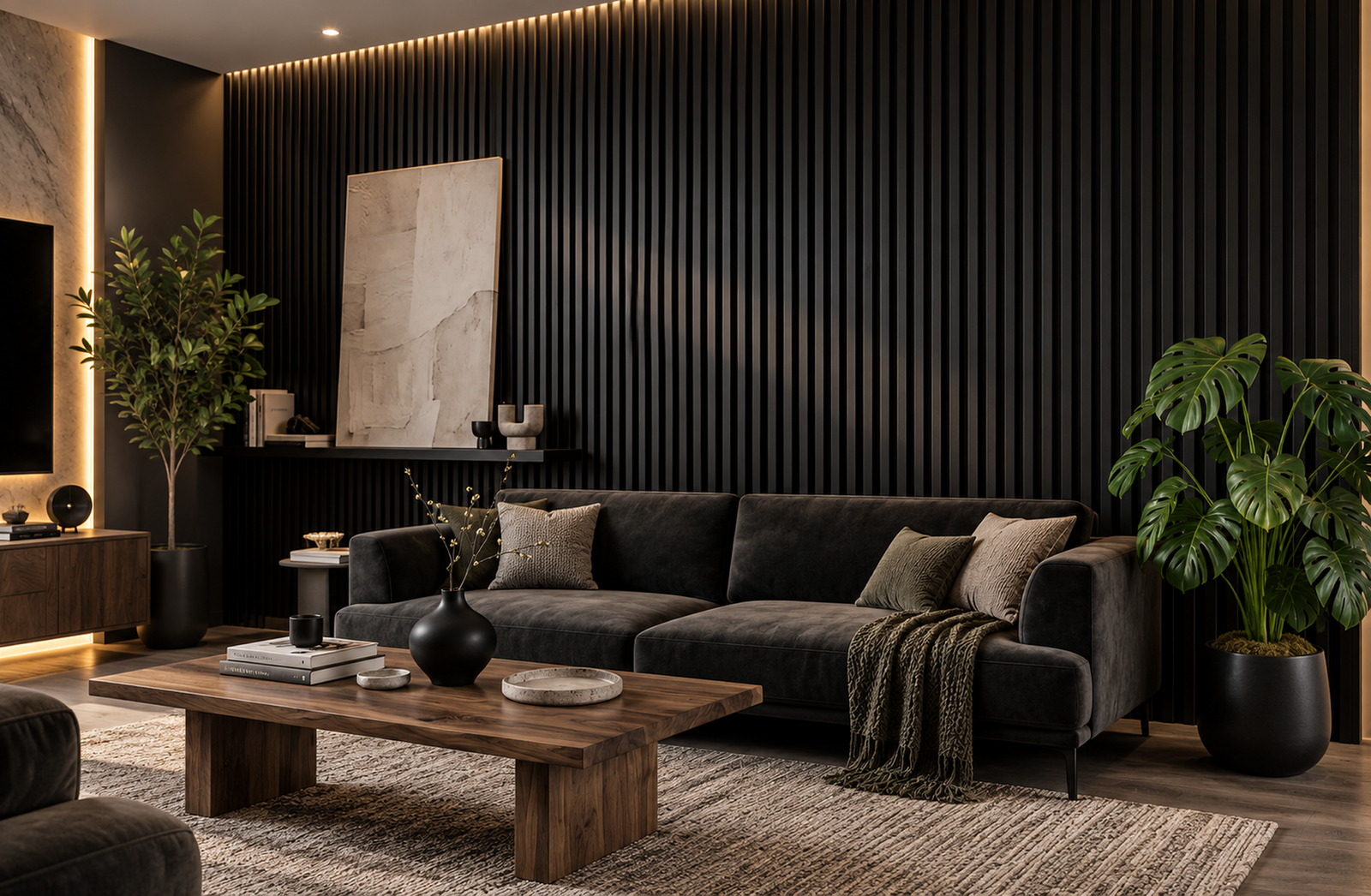
Fluted wall panels have gone from a designer detail to the single most requested finish in Karachi homes, and it is easy to see why. One wall, one day of work, and a plain room reads as a hotel lobby. We have just added our full WPC fluted range to the shop, so here is what the profiles actually are, where each one belongs, and how to pick the right one for your space.
What is a fluted wall panel?
A fluted panel is a flat board with vertical grooves running down its face. The grooves catch light on one side and throw shadow on the other, so a flat wall gains depth and rhythm without any change to the room’s footprint. Classical architecture used the same trick on stone columns, which is where the name comes from.
Ours are WPC, a wood plastic composite. That matters in Karachi more than it does almost anywhere else. WPC does not swell in humidity, termites have no interest in it, and a damp wall behind the panel will not rot it the way it would rot MDF. It also wipes clean, which counts for a lot in a city with this much dust in the air.
The seven profiles in our range
All seven share the same material and the same 9.5 foot (2900mm) length. What changes is the shape of the face, and that changes the mood of the room completely.
Fluted
The classic. Even, medium-depth grooves at a regular spacing. This is the safe, correct choice for a living room feature wall or a TV back wall, and it is where most people should start. It photographs well, it suits both light and dark finishes, and it does not date.
Deep Fluted
Same idea, cut deeper. The shadows are stronger and the wall reads as more sculptural, which is why it works best in large rooms and double-height spaces where a shallow profile would get lost. In a small bedroom it can feel heavy, so give it room to breathe.
Slat
Flat-topped strips separated by square channels, closer to Scandinavian slat walls than to classical fluting. Cleaner and more contemporary than the fluted profiles, and the one to pick if your furniture is minimal and you want the wall to stay quiet.
Round Slat
Half-round ribs instead of flat ones. The curve softens the whole wall, so this is the profile for bedrooms, headboard walls and anywhere you want warmth rather than edge. It is also more forgiving of uneven light than the sharp profiles.
Wave
A continuous curved surface with no hard edges at all. This is the statement profile. One wave wall in a reception area, a salon or a restaurant does the work of an entire design scheme. Use it alone, never alongside another profile.
Textured
A surface finish rather than a groove profile, with the grain or stone texture raised so you feel it as well as see it. Good for full wall cladding where you want interest without the strong vertical lines that fluting creates.
Flat Wood-Grain
No profile, just a clean flat board in a wood finish. The workhorse of the range. Use it for ceilings, for wardrobe fronts, for the three walls that surround your one fluted feature wall, and for commercial jobs where the budget has to stretch.
A rule that saves most people from a mistake: one profile per room. Fluted on the feature wall and flat wood-grain everywhere else looks designed. Fluted on one wall and wave on another looks like two different rooms arguing.
Specifications
| Detail | Specification |
|---|---|
| Material | WPC (wood plastic composite) |
| Panel length | 9.5 feet (2900mm) |
| Panel width | (confirm per profile) |
| Thickness | (confirm per profile) |
| Coverage per panel | (confirm) |
| Water resistance | Water resistant, suitable for humid rooms |
| Termite resistance | Termite proof |
| Fitting | Adhesive, clips or direct screw fixing |
| Use | Interior walls and ceilings |
Why WPC suits Karachi homes
Three local conditions decide whether wall panelling lasts here, and WPC answers all three.
Humidity. Coastal air keeps moisture in our walls year round. Solid wood and MDF both take that moisture on, swell, and eventually separate at the joints. WPC does not absorb it, so the panel you fit in December looks the same in July.
Termites. Anyone who has lost a wooden wardrobe knows the problem. There is no cellulose for termites to feed on in a WPC panel, so the question does not arise.
Dust. The grooves in any fluted panel will collect dust. WPC lets you run a dry cloth or a vacuum brush down the channels without damaging the finish, which is not true of fabric-wrapped acoustic panels or unsealed timber.
Where to use each profile
- TV and living room feature wall: Fluted or Deep Fluted, in a dark finish so the screen does not fight the wall.
- Bedroom headboard wall: Round Slat or Slat, in a warm mid-tone.
- Entrance and hallway: Fluted, full height, to make a narrow space feel taller.
- Reception, salon, restaurant: Wave for the main wall, Flat Wood-Grain for the rest.
- Office and meeting rooms: Slat, which keeps a professional look and helps soften echo.
- Ceilings and wardrobe fronts: Flat Wood-Grain.
How many panels do you need?
Measure the width of the wall in feet, then divide by the width of the panel you have chosen. Round up, then add one panel. The spare covers cutting waste around switches and sockets, and it gives you a matching offcut if a panel is ever damaged later. Height is rarely an issue, since the 9.5 foot panel clears a standard Karachi ceiling in one piece with no horizontal join.
Send us your wall measurements on WhatsApp and we will work out the panel count and the total for you before you order.
Fitting, in short
Panels go onto any sound, dry, reasonably flat wall. Most jobs use construction adhesive applied in a zigzag down the back of the panel, pressed on and held, working from one corner across the wall so the grooves stay aligned. On uneven walls a batten frame is fitted first and the panels screwed or clipped to it. Cutting is done with an ordinary fine-tooth saw. Matching trims close the top, bottom and outside corners for a finished edge.
Our team can supply fitted as well as supply only. (confirm whether you offer installation)
Frequently asked questions
Are fluted wall panels suitable for bathrooms?
For a bathroom wall away from direct spray, yes, because WPC does not absorb water. We would not recommend them inside a shower enclosure.
Will they fade in sunlight?
On a wall in strong, direct sun for most of the day, any panelled finish will lighten over several years. On a normal interior wall this is not a practical concern.
Can panels be removed later?
Panels fitted to a batten frame come off cleanly. Panels glued directly to plaster will take some of the plaster surface with them, so plan for making good if you expect to change the wall.
Do they help with sound?
A fluted or slatted surface breaks up reflections and reduces echo noticeably within the room. It is not soundproofing, and it will not stop noise passing through the wall to the next room.
What does a feature wall cost?
(confirm current per-panel pricing and a typical 12 foot wall example)
The full WPC fluted range is live now, in every profile and finish.
Shop WPC wall panels